

Mike Masoud | November 14, 2026
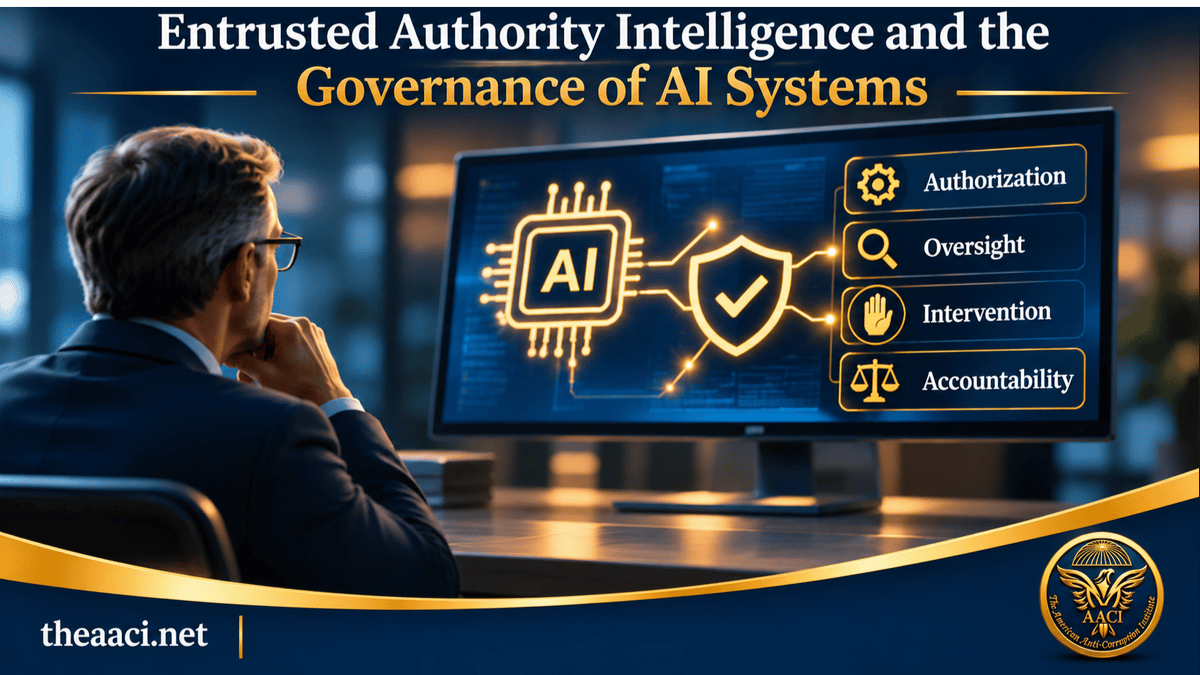
The Governance Question Behind Artificial Intelligence
Organizations are increasingly using artificial intelligence (AI) to analyze information, prepare recommendations, operate software, and perform activities that previously required direct human involvement.
Some advanced AI systems, commonly described as AI agents, can perform sequences of activities with limited human intervention. Depending on their design and permissions, these systems may retrieve information, interact with applications, generate reports, or initiate actions affecting organizational operations.
These developments raise an important governance question:
When an organization delegates authority to an AI system, who ensures that the system continues to operate within the limits of that authority?
The question concerns more than technology. It concerns the responsible exercise of entrusted authority.
Entrusted Authority Intelligence (EAI), developed by Mike Masoud and published by The American Anti-Corruption Institute (AACI) on June 9, 2026, addresses the competence and judgment required to exercise entrusted authority responsibly, discharge fiduciary duties, reduce corruption exposure, manage governance risks, and support the achievement of organizational objectives (Masoud, 2026).
EAI identifies three essential and interdependent elements: competence, integrity, and decision-making effectiveness.
Although EAI focuses on the human exercise of entrusted authority, it provides a useful perspective for examining how organizations delegate limited operational authority to AI systems while retaining responsibility for governing its exercise.
A recent development from OpenAI offers a practical illustration of this governance challenge.
What Is OpenAI’s Control Room?
On November 9, 2026, OpenAI introduced Control Room, an internal system designed to track AI workloads across its research infrastructure and stop further model output when safety or security concerns require intervention (OpenAI, 2026).
To understand its significance, consider what an AI workload means.
A workload is an activity assigned to an AI system. In OpenAI’s research environment, this may involve conducting experiments, evaluating AI models, processing information, or carrying out automated research activities.
Some of these activities involve AI agents capable of performing multiple steps without continuous human direction.
Monitoring such activities is insufficient unless the organization also possesses reliable mechanisms to intervene when necessary.
Control Room addresses this problem by connecting AI research activities to a centralized authorization mechanism.
In simple terms, it allows OpenAI to determine whether a particular AI workload remains authorized to receive further model output—and to deny that output when authorization is withdrawn.
Control Room is not presented as a commercial product available for organizations to install. It is an internal system deployed within OpenAI’s research infrastructure.
Its importance to governance professionals lies in the principles underlying its operation.
How Does Control Room Work?
Control Room operates through a sequence of authorization and intervention procedures.
1. Registration and Approval
Before AI research workloads involving autonomous model operations begin, OpenAI requires them to be associated with an approved safety case.
A safety case provides documented justification addressing relevant safety considerations.
The workload registers with Control Room and receives a unique identification number. This allows the system to distinguish one research activity from another.
2. Authorization During Operation
When the workload needs additional output from an AI model, it sends a request to the system responsible for running that model.
Before providing the requested output, that system checks with Control Room to determine whether the workload remains authorized.
If authorization remains valid, the request may proceed.
3. Detection of a Potential Problem
OpenAI uses monitoring systems to examine the behavior of certain advanced AI research activities.
When monitoring identifies potentially concerning behavior, a person or monitoring system may determine that the activity should be stopped.
The decision is communicated to Control Room.
4. Withdrawal of Authorization
Control Room records that the identified workload is no longer authorized to receive further model output.
When the workload subsequently requests additional output, the authorization check fails, and the request is denied.
Importantly, this mechanism does not depend on the workload voluntarily obeying an instruction to stop.
5. Enforcement and System Failure
OpenAI reports that Control Room can prevent further model progress within a maximum of 35 seconds after receiving an intervention instruction.
This interval reflects a temporary authorization-caching mechanism used to handle the volume of requests. OpenAI states that it is working to reduce the interval.
The system also incorporates a fail-closed approach. If the Control Room authorization service becomes unavailable, the protected model-serving infrastructure denies further requests rather than automatically allowing them (OpenAI, 2026).
At the time of OpenAI’s publication, this fail-closed protection had been deployed for frontier-model research workloads, with deployment across remaining research workloads underway.
These are OpenAI’s reported operating characteristics. They should not be interpreted as independently verified guarantees applicable to other AI systems or organizations.

Why Does This Matter to Decision-Makers?
Consider a familiar organizational situation.
A company delegates authority to an employee to approve purchases up to a specified amount.
The delegation establishes the limits within which the employee may exercise that authority. However, effective internal control also requires the organization to determine whether the authorization remains valid, prevent transactions exceeding approved limits, and withdraw access when necessary.
Suppose management revokes the employee’s purchasing authority.
If the purchasing system continues accepting the employee’s approvals, the organization has a control problem—even though management has formally withdrawn the authorization.
The difference between withdrawing authority and effectively enforcing that withdrawal is fundamental.
The same principle applies when organizations delegate limited operational authority to AI systems.
An AI agent may possess the technical capability to access information, interact with applications, or initiate transactions. However, technical capability does not establish legitimate organizational authority.
The organization must determine the scope of the authority granted to the AI system, the conditions under which it may be exercised, and the controls required to enforce those conditions.
Control Room illustrates how an organization can incorporate continuing authorization into the operation of AI systems.
It also demonstrates why effective intervention should not depend exclusively on the cooperation of the system being supervised.
The EAI Perspective: Authority Requires Competence, Integrity, and Effective Judgment
Entrusted Authority Intelligence emphasizes that governance effectiveness depends significantly on the quality with which individuals exercise the authority entrusted to them.
Its three essential elements are particularly relevant to decisions involving AI.
Competence
Decision-makers must possess sufficient understanding to evaluate the authority they propose to delegate to AI systems.
This does not mean that directors, executives, or auditors must become software engineers.
It means they should understand the organizational purpose of an AI system, the material risks associated with its operation, the information and resources it can access, and the controls necessary to supervise the exercise of its authorized capabilities.
For example, a board approving the use of an AI agent in financial operations should understand whether the system merely identifies unusual transactions or also possesses authority to initiate payments.
These are materially different levels of authority and risk.
Integrity
Entrusted authority must be exercised for legitimate organizational purposes.
Decision-makers should not use AI systems to bypass approval requirements, conceal improper activities, avoid accountability, or weaken established controls.
AI can increase the speed and scale of organizational activities. It can also increase the consequences of poor judgment or improper conduct.
Integrity therefore remains essential when decisions about AI authorization, deployment, monitoring, and intervention are made.
Decision-Making Effectiveness
Competence and integrity must be translated into responsible action.
A decision-maker may understand that an AI system presents material risks and genuinely intend to manage those risks. Nevertheless, governance may remain ineffective if appropriate controls are not implemented or necessary interventions are delayed.
The ability to recognize a problem is not equivalent to the ability to address it.
Control Room offers an example of how technical mechanisms can support intervention decisions.
However, the existence of such mechanisms does not establish that the individuals responsible for using them will consistently exercise sound judgment.
EAI directs attention to the people who authorize, oversee, challenge, and intervene—not merely to the technology through which their decisions are implemented.
What Control Room Does Not Guarantee
Control Room illustrates an important control principle, but it should not be regarded as a complete solution to AI governance.
OpenAI’s system is designed to prevent stopped research workloads from receiving further model output.
That does not necessarily mean that the underlying research process is terminated or that previously completed actions are reversed.
For example, if an AI agent has already transmitted confidential information to an unauthorized recipient, preventing further model output does not retrieve that information.
Similarly, if an agent has already initiated a financial transaction, stopping subsequent AI activity does not necessarily cancel the transaction.
Organizations must therefore consider additional safeguards, including restrictions on system access, transaction approval requirements, reliable records, incident investigation, recovery procedures, and human oversight.
Another important distinction concerns the difference between technical control and governance effectiveness.
A system may operate according to its technical design while the underlying authorization decisions remain inappropriate.
If management grants excessive authority, fails to identify material risks, or ignores warning signals, even technically reliable controls may be insufficient.
Effective AI governance requires both appropriate technical safeguards and the responsible exercise of human authority.
The Questions Decision-Makers Should Ask
The governance issues illustrated by Control Room can be translated into practical questions for boards, executives, internal auditors, compliance professionals, regulators, and other individuals entrusted with oversight responsibilities.
Before delegating operational authority to AI systems, decision-makers should ask:
- Purpose: What legitimate organizational objective justifies granting authority to this AI system?
- Authority: What authority will be delegated, and what are its explicit limits?
- Responsibility: Who is authorized to approve, modify, suspend, or revoke that authority?
- Access: Which records, applications, resources, and external systems may the AI system access?
- Monitoring: How will the organization identify unexpected, unauthorized, or potentially harmful conduct?
- Intervention: Can authorized personnel effectively prevent the system from continuing an activity when necessary?
- Evidence: What reliable records demonstrate the system’s activities, permissions, interventions, and outcomes?
- Accountability: Who remains accountable for the authorization, oversight, and consequences of the system’s operation?
These questions are not a substitute for a comprehensive governance framework. They are intended to strengthen the quality of oversight and the judgment exercised when delegating authority to AI systems.
Their value also depends on the quality of the answers.
A policy stating that AI activities are monitored is not evidence that monitoring operates effectively.
Similarly, a procedure allowing management to suspend an AI system is not sufficient unless the organization can demonstrate that the intervention mechanism works when required.
Decision-makers should therefore seek evidence of implementation, operation, testing, exceptions, and corrective action.

From Technical Control to Governance Accountability
OpenAI’s Control Room is significant because it illustrates how continuing authorization and enforceable intervention can be incorporated into advanced AI operations.
However, its broader significance lies in the governance questions it raises.
Who decides which authority should be delegated to AI systems?
Who determines the appropriate limits?
Who evaluates the adequacy of monitoring?
Who decides when intervention is necessary?
And who remains accountable when the controls fail or when the original authorization was inappropriate?
These questions cannot be answered by technology alone.
Entrusted Authority Intelligence provides a perspective for examining the competence, integrity, and decision-making effectiveness of those responsible for making and implementing such decisions.
The relationship between EAI and Control Room is analytical, not institutional or technological. Control Room was not developed as an application of EAI, and its existence does not independently validate the AACI concept.
Rather, Control Room provides a contemporary example through which the governance implications of entrusted authority can be examined.
As organizations increasingly delegate authority to AI systems, they must ensure that such delegation does not diminish the accountability of those entrusted with authorizing, overseeing, and controlling the exercise of that authority.
Directors, executives, and other decision-makers remain accountable for discharging their respective responsibilities in accordance with applicable legal requirements and organizational governance arrangements.
The authorization of an AI system to exercise specified authority does not transfer those responsibilities to the technology.
Conclusion: The Responsible Exercise of Human Authority Comes First
Artificial intelligence is changing how organizations perform activities, process information, and make decisions.
Yet increasing technological capability does not diminish the importance of effective governance.
On the contrary, when organizations delegate greater operational authority to AI systems, the competence and judgment of those responsible for that delegation become increasingly consequential.
OpenAI’s Control Room illustrates an important principle: organizations should possess effective means to determine whether AI activities remain authorized and to intervene when necessary.
Entrusted Authority Intelligence extends the discussion to the human responsibilities behind those mechanisms.
Competence helps decision-makers understand the authority being delegated and the risks involved.
Integrity helps ensure that authority is exercised for legitimate purposes.
Decision-making effectiveness helps translate both into timely, reasoned, and accountable action.
The delegation of authority to an AI system does not diminish the accountability of those entrusted with governing its exercise.
That accountability remains with the responsible individuals and institutions, subject to their respective duties and applicable governance arrangements.
References
Masoud, M. (2026) Entrusted Authority Intelligence: An Anti-Corruption Governance Concept. Version 1.0. The American Anti-Corruption Institute (AACI), 9 June. Available at: https://www.theaaci.net/Entrusted-Authority-Intelligence (Accessed: 14 November 2026).
OpenAI (2026) ‘Control Room: A central system to track and stop model workloads across our research infrastructure’. Available at: https://openai.com/index/control-room/ (Accessed: 14 November 2026).
About the Author
Mike Masoud is the Senior Director of The American Anti-Corruption Institute (AACI) in the Middle East and Africa. He is the developer of Entrusted Authority Intelligence (EAI), an anti-corruption governance concept published by The AACI in June 2026. His professional work focuses on corruption prevention, internal control, governance accountability, and the responsible exercise of entrusted authority.
Editorial and Intellectual Property Note
This article presents an independent governance analysis by Mike Masoud through the Entrusted Authority Intelligence concept published by The American Anti-Corruption Institute (AACI).
Descriptions of OpenAI’s Control Room are based on publicly available information attributed to OpenAI. Any accompanying AACI diagrams are independent conceptual illustrations and do not reproduce OpenAI’s proprietary visual materials.
No affiliation, endorsement, sponsorship, or collaboration between OpenAI and AACI is implied.