Editorial Team | September 23, 2026
On September 22, 2026, The American Anti-Corruption Institute (AACI) delivered Board Oversight, Codex, and the Future of Corruption Prevention for the first time in the Middle East through the UKM-Qatar Professional Development Center.
The webinar was delivered by Mike Masoud, Senior Director of The American Anti-Corruption Institute (AACI) in the Middle East and Africa, and addressed an increasingly important question for boards, executive management, and other decision-makers:
Why does anti-corruption strategy require digital and AI competence at the board level?
The event was made possible through cooperation between the UKM-Qatar Professional Development Center and Tomorrow’s Advice Global, The AACI’s exclusive strategic partner in Lebanon and Kuwait.


Governance During a Period of Rapid Technological Change
Artificial intelligence is rapidly expanding what organizations can analyze, automate, build, monitor, and execute.
AI-assisted technologies can support data analysis, transaction testing, monitoring, documentation, application development, workflow automation, and other organizational activities. These capabilities create significant opportunities for organizations seeking to strengthen corruption prevention and improve visibility into areas of institutional risk.
However, increasing technological capability does not reduce the importance of governance.
It increases it.
Boards and executive management do not need to become programmers or technical specialists. They do, however, need sufficient digital and AI competence to understand what management is building, purchasing, deploying, or relying upon—and to challenge the assumptions, controls, data, validation processes, limitations, and accountability arrangements surrounding those technologies.
The webinar therefore approached AI not primarily as a technology issue, but as a governance and oversight issue.
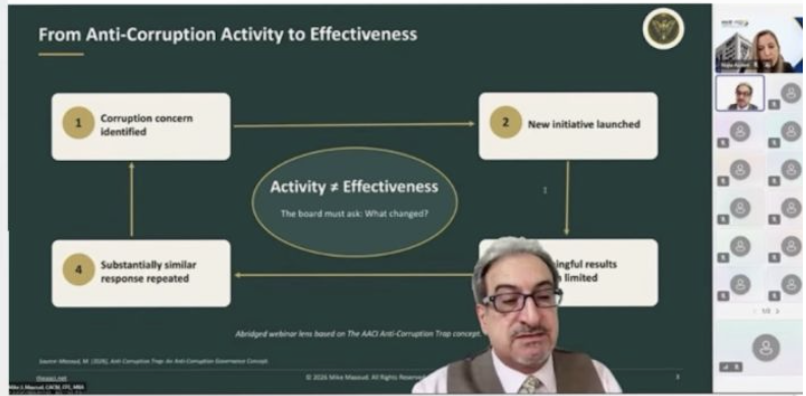
From Anti-Corruption Activity to Effectiveness
A central theme of the webinar was the distinction between anti-corruption activity and anti-corruption effectiveness.
Organizations may adopt policies, conduct training, establish committees, implement reporting mechanisms, introduce dashboards, or deploy new technologies. These activities may all be appropriate.
Their existence, however, does not by itself demonstrate that corruption exposure has been reduced.
The webinar applied the AACI concept of the Anti-Corruption Trap as an effectiveness lens. The concept highlights the danger of repeatedly implementing anti-corruption initiatives without obtaining sufficient evidence that underlying corruption exposure is meaningfully declining.
For boards, this leads to a fundamental question:
What has actually improved?
Technology should therefore be evaluated not merely by whether it has been implemented, but by whether it contributes to measurable improvement in the organization’s ability to prevent, identify, control, and respond to corruption risks.
Competent Questioning as a Board Discipline
The webinar also examined Competent Questioning, an AACI concept emphasizing clear, relevant, timely, and evidence-seeking questions.
For boards, the distinction between a weak question and a competent question can materially affect the quality of oversight.
Rather than asking only whether an organization uses AI, for example, a board can ask:
What corruption-risk problem is the technology intended to address?
Rather than asking whether a system has been tested, the board can ask:
What was tested, against what benchmark, by whom, and what evidence supports the conclusion?
Competent Questioning also requires evaluation of the answer. A management response should not be accepted merely because it sounds technically sophisticated or is presented through a polished dashboard.
The quality of oversight depends not only on the questions asked, but also on the discipline applied in evaluating the evidence provided.
AI-Assisted Tools and Internal Control
Another major area of discussion was the relationship between AI-assisted tools and internal control.
Technology can support visibility, testing, monitoring, documentation, and analysis. But technology should not be mistaken for internal control itself.
The webinar emphasized that AI-assisted tools must operate within an effective system of internal control, including the control environment, risk assessment, control activities, information and communication, and monitoring activities.
The familiar internal control questions therefore remain highly relevant:
Is authority properly assigned?
Are incompatible duties appropriately separated?
Are changes reviewed and approved?
Are exceptions investigated?
Is information reliable?
Are deficiencies communicated?
And is corrective action monitored?
AI changes the technical environment. It does not eliminate these fundamentals.
Eight Questions for Board Oversight
The webinar also presented eight questions that boards should consider before approving, funding, or relying on an AI-assisted tool for corruption prevention:
- What corruption-risk problem is the tool intended to address?
- What data will the tool use, and are those data reliable?
- Who owns the tool and its outputs?
- How will the tool be tested and validated?
- What red flags will be escalated, and to whom?
- How will false positives and false negatives be handled?
- Will internal audit or another sufficiently independent assurance function review the logic, governance, and results?
- How will the board receive evidence of effectiveness?
These questions do not require directors to write code.
They require directors to govern.
The Difference Is Governance
One of the central messages of the webinar was straightforward:
Technology can strengthen visibility, testing, documentation, and speed. It can also accelerate weak assumptions, conceal weak data behind sophisticated outputs, and create false comfort. The difference is governance.
As AI capabilities continue to expand, boards and executive management will increasingly need to distinguish between what technology can do and what an organization should permit it to do, under what conditions, with what controls, and with what accountability.
For those entrusted with authority, digital and AI competence is therefore becoming increasingly relevant to responsible governance.
The question is no longer simply whether organizations will use AI.
The more important question is:
Are those entrusted with authority sufficiently prepared to govern its use responsibly?
Cooperation and Next Steps
The AACI extends its appreciation to the leadership and professional team of the UKM-Qatar Professional Development Center and to Tomorrow’s Advice Global for their cooperation and professional efforts in making this first Middle East delivery possible.
The two-day executive program associated with the webinar will also be offered in Qatar through the UKM-Qatar Professional Development Center, providing participants with an opportunity to move from informed awareness toward deeper practical competence through cases, exercises, governance safeguards, and applied board-level analysis.
The UKM-Qatar Professional Development Center’s LinkedIn coverage of the webinar is available here: