

Mike Masoud | September 14, 2026
Organizations devote considerable attention to deciding who should have authority.
Boards appoint executives. Governments designate public officials. Institutions delegate approval rights. Committees receive mandates. Managers acquire discretion.
But there is a more difficult question:
What tells us that the person who has been given authority is capable of exercising it responsibly?
A title does not answer that question.
Neither does seniority, professional experience, access to information, or the existence of formal policies and internal control.
Two individuals may hold equivalent positions, possess comparable authority, and operate within the same governance structure—yet exercise that authority very differently.
That difference matters.
Authority Is Not the Same as the Capacity to Exercise It
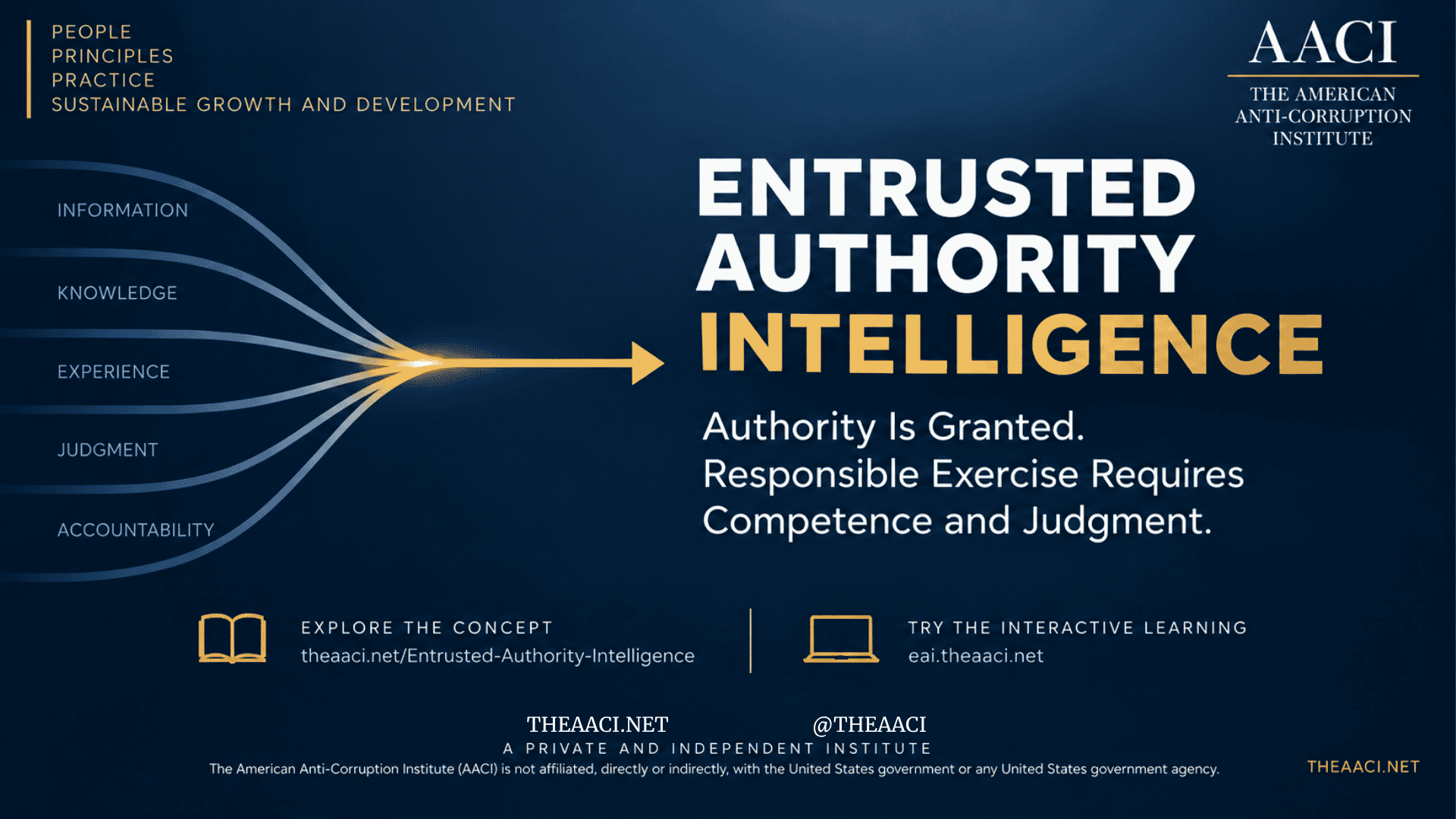
The American Anti-Corruption Institute (AACI) defines Entrusted Authority Intelligence as:
The concept brings attention to the human dimension of governance.
Governance structures matter. Internal control matters. Policies, reporting mechanisms, risk management, and oversight all matter.
But none of them makes decisions on its own.
People do.
And when those people lack the competence to understand the matter, the integrity to exercise authority for its proper purpose, or the decision-making effectiveness required to turn sound judgment into responsible action, even well-designed governance systems can be weakened.
The Question Boards Should Be Asking
Organizations frequently ask:
Who has authority to make this decision?
That is necessary—but insufficient.
A stronger governance question is:
Does the person exercising this authority possess the competence and judgment required to exercise it responsibly?
That question changes the discussion.
It moves governance beyond organizational charts and delegation matrices toward the quality with which entrusted authority is exercised.
It also reminds us that a favorable outcome does not necessarily prove that a decision was responsibly made, just as an unfavorable outcome does not automatically demonstrate poor judgment.
What matters is the quality of the decision process given the information, risks, alternatives, responsibilities, and circumstances that existed when the authority was exercised.
A Governance Issue Worth Examining
Authority can be assigned in minutes.
Developing the competence, integrity, and decision-making effectiveness required to exercise it responsibly is considerably more demanding.
That may be one of the most important distinctions organizations overlook.
Explore the Entrusted Authority Intelligence Interactive Learning Experience:
The question is no longer simply who has authority. It is whether they are equipped to exercise it responsibly.