August 17, 2026
Boards and senior decision makers are surrounded by information. They receive reports, presentations, risk assessments, legal opinions, audit findings, forecasts, dashboards, and recommendations. They also ask questions.
Yet neither the volume of information nor the existence of questions guarantees a sound decision.
A critical issue is often overlooked: Was the questioning itself competent?
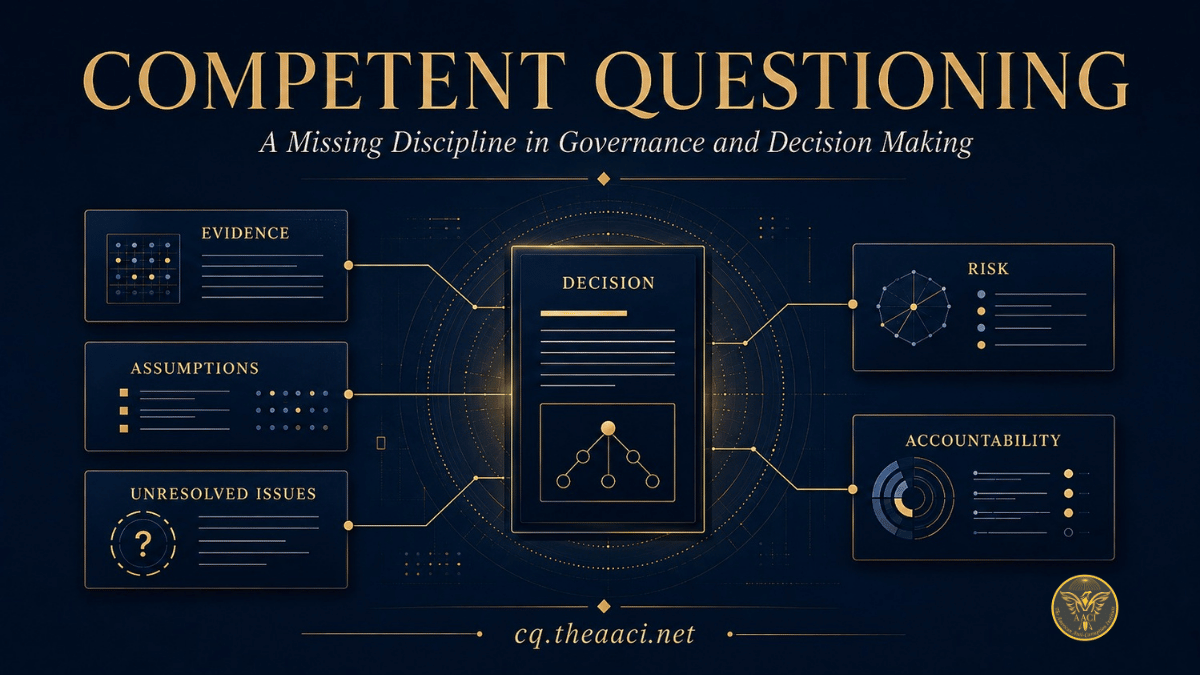
Competent Questioning addresses that gap. Published by The American Anti-Corruption Institute (AACI) and forming part of The AACI Anti-Corruption Framework, the concept treats questioning not as a conversational skill or procedural formality, but as a disciplined governance capability. It requires those exercising entrusted authority to understand the matter sufficiently, identify relevant risks, ask informed and evidence-seeking questions, evaluate the answers, test supporting evidence, pursue unresolved matters, and clarify accountability.
That distinction matters.
A director who asks whether a policy exists has asked a question. A director who examines whether the policy operates effectively, what evidence supports that conclusion, what exceptions occurred, who approved them, and what unresolved exposure remains is exercising a different level of oversight.
The same principle applies across management, internal control, risk management, audit, compliance, procurement, regulation, and public administration.
From Review to Examination
Formal processes can create false assurance. A transaction may have been approved yet remain improper. An internal control may be documented yet fail in practice. A risk report may be complete in form yet weak in substance. An expert opinion may be technically impressive yet rest on assumptions the decision maker does not understand. A committee may have considered a matter without adequately testing the evidence supporting it.
Competent Questioning changes the standard from “Was the matter reviewed?” to “Was it examined well enough to justify reliance and action?”
Its contribution to anti-corruption is particularly significant. Corruption can exploit discretion, conflicts of interest, weak control activities, unusual exceptions, third-party relationships, concentration of authority, urgency, secrecy, and the passive acceptance of explanations. Competent Questioning gives those exercising authority a disciplined way to examine these conditions before an approval, payment, appointment, contract, or other decision becomes institutional exposure.
But its value extends well beyond corruption prevention.
In governance, it strengthens the quality of board and committee oversight. In internal control, it helps distinguish internal controls that exist on paper from controls that operate in substance. In risk management, it challenges assumptions and tests whether identified risks and residual exposures are understood. In management, it improves accountability by requiring recommendations and exceptions to withstand informed scrutiny. In decision making generally, it reduces dependence on confidence, hierarchy, reputation, and procedural completion as substitutes for proper and adequate evidence.
The Competence of the Questioner Matters
Here lies one of the concept’s most important contributions: the quality of questioning depends on the competence of the person asking the question.
A decision maker cannot effectively challenge what he or she does not sufficiently understand. Competent Questioning therefore requires knowledge, professional skepticism, judgment, and ethical courage. It also requires recognizing the limits of one’s competence and obtaining qualified assistance when necessary. Expert assistance may strengthen a decision, but it does not transfer the responsibility of the person ultimately exercising authority.
This has important implications for legal and professional responsibility. Competent Questioning does not create or define a director’s or executive’s legal duties; those arise from applicable law, regulation, governing documents, and professional standards. But wherever those duties require informed oversight, reasonable care, independent judgment, or responsible approval, the ability to question competently can become central to discharging them in substance rather than merely in form.
The question for a board member or senior executive, therefore, should not simply be:
Did I ask questions?
It should be:
Did I understand enough, question effectively enough, evaluate the evidence carefully enough, and pursue unresolved matters far enough to justify the decision I made?
That is the discipline Competent Questioning brings to governance.
Explore Competent Questioning
The American Anti-Corruption Institute provides an interactive learning experience through which professionals can examine the Competent Questioning process, evaluate answers and evidence, work through practical situations, and explore how the concept applies to the exercise of entrusted authority.