

Editorial Team
Published June 26, 2026
Anti-corruption initiatives are usually introduced to strengthen integrity, improve accountability, and reduce corruption exposure. They may include new policies, training programs, internal control enhancements, transparency measures, whistleblowing systems, oversight committees, legislative reforms, investigative units, or governance reforms.
These initiatives often begin with sincere commitment. Leaders may recognize the harm caused by corruption and seek to respond through visible institutional action. However, visible action is not the same as effective action.
This distinction is central to the Anti-Corruption Trap, an anti-corruption governance concept authored by Mike Masoud and published by The American Anti-Corruption Institute (AACI).
The concept addresses a practical governance problem: organizations, institutions, and governments may repeatedly implement anti-corruption initiatives that demonstrate commitment to reform but fail to achieve meaningful reductions in corruption exposure. Over time, the institution may continue introducing substantially similar responses despite evidence that prior approaches did not produce meaningful results.
The result is not merely an implementation failure. It is a failure of institutional learning.
What Is the Anti-Corruption Trap?
Definition
An Anti-Corruption Trap is a condition in which an organization, institution, or government repeatedly implements anti-corruption initiatives that demonstrate commitment to reform but fail to achieve meaningful reductions in corruption exposure because of deficiencies in competence, resources, implementation capability, institutional incentives, political support, or strategic alignment. The trap becomes self-reinforcing when evidence of failure does not lead to substantive corrective action and substantially similar approaches continue to be repeated despite recurring ineffective results.
In practical terms, the Anti-Corruption Trap shifts attention from the existence of anti-corruption efforts to their effectiveness. It asks whether anti-corruption activity is producing meaningful reductions in corruption exposure, or whether the institution is repeating familiar responses that create the appearance of progress without addressing the underlying drivers of failure.
Why This Concept Contributes to Anti-Corruption Governance
The contribution of the Anti-Corruption Trap is that it gives a precise governance language and diagnostic structure to a recurring institutional pattern: anti-corruption responses may continue, resources may be consumed, and documentation may increase, while meaningful reductions in corruption exposure do not materialize. The concept does not merely ask whether an institution is acting. It asks whether the institution is learning, correcting, and reducing corruption exposure.
Why the Concept Matters
Much anti-corruption discussion focuses on why corruption persists. Common explanations include weak institutions, inadequate enforcement, political interference, insufficient accountability, economic incentives, and entrenched corrupt networks. These factors remain important.
The Anti-Corruption Trap adds a different question: why do anti-corruption responses themselves repeatedly fail to achieve their intended objectives?
This question matters because an institution may appear active, committed, and reform-oriented while still failing to reduce corruption exposure. Policies may exist. Training may be completed. Reports may be issued. Committees may meet. Resources may be allocated. Yet recurring weaknesses may continue to appear in audits, investigations, assessments, regulatory findings, or governance reviews.
The concept therefore challenges a dangerous assumption: that anti-corruption activity is evidence of anti-corruption effectiveness.
It is not.
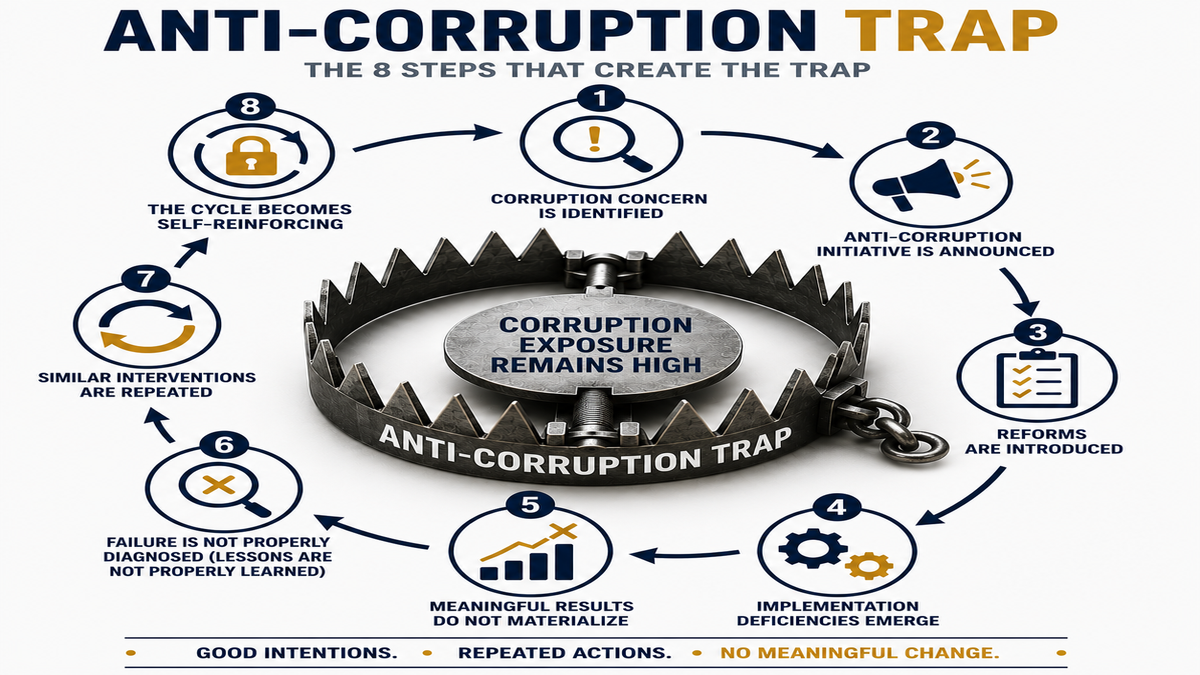
The 8-Step Anti-Corruption Trap Framework
The Anti-Corruption Trap Framework describes how this condition may develop through a recurring cycle:
- Corruption concern is identified.
- An anti-corruption initiative is announced.
- Reforms are introduced.
- Implementation deficiencies emerge.
- Meaningful results do not materialize.
- Failure is not properly diagnosed, and lessons are not properly learned.
- Similar interventions are repeated.
- The cycle becomes self-reinforcing.

The framework should not be understood as a rigid sequence that applies identically in every institution. Some stages may overlap, and institutions may enter the cycle at different points. Its value lies in helping decision-makers recognize a recurring pattern: anti-corruption efforts continue, but meaningful reductions in corruption exposure remain elusive.
Good Intentions Are Not Enough
The Anti-Corruption Trap does not question the importance of good intentions. Many anti-corruption initiatives begin with genuine concern, responsible leadership, and a sincere desire to improve governance.
However, good intentions alone do not reduce corruption exposure.
Commitment reflects a desire to achieve an outcome. Effectiveness reflects the ability to achieve it. The two are related, but they are not the same.
Institutions become vulnerable to the trap when commitment, activity, and documentation are treated as substitutes for evidence of results. A policy may be adopted without changing behavior. Training may be delivered without improving competence. A committee may be established without strengthening accountability. A reform may be announced without changing the incentives that allowed corruption exposure to persist.
For this reason, anti-corruption efforts should be evaluated according to their results, not merely according to their intentions.
Why Institutions Fall Into the Trap
The Anti-Corruption Trap rarely develops because institutions deliberately choose ineffective responses. More often, it develops because the conditions required for effective reform are underestimated, ignored, or misjudged.
The published concept identifies several drivers that may contribute to the trap, including competence deficiencies, resource constraints, implementation capability deficiencies, institutional incentive failures, resistance from entrenched interests, strategic misalignment, measurement failure, and institutional learning failure.
These drivers rarely operate in isolation. Weak competence may undermine implementation. Poor implementation may weaken results. Weak measurement may conceal failure. Incentives may discourage honest evaluation. Resistance may prevent correction. Learning failure may allow all of these conditions to continue.
The trap is therefore best understood as the cumulative result of interacting deficiencies that prevent anti-corruption responses from evolving despite evidence of limited effectiveness.
Indicators That the Trap May Be Emerging
The Anti-Corruption Trap is not always easy to recognize because institutions operating within it may appear active and reform-oriented.
Several indicators may warrant closer examination:
- Substantially similar weaknesses continue to appear over time.
- Previous recommendations are not effectively implemented.
- Current anti-corruption responses do not materially differ from earlier unsuccessful responses.
- Reliable evidence of reduced corruption exposure is absent.
- Implementation failures are not examined honestly.
- Lessons from previous initiatives do not influence current decisions.
- The scale of the response is not proportionate to the scale of the corruption risk.
- Stakeholders do not observe meaningful improvement.
These indicators do not automatically prove that an institution is operating within an Anti-Corruption Trap. They are warning signs that the institution may need to examine whether its anti-corruption responses are becoming repetitive, ineffective, or disconnected from results.
Practical Implications for Governance Professionals
The Anti-Corruption Trap has direct implications for boards of directors, executive management, public officials, regulators, internal auditors, compliance professionals, investigators, donors, development agencies, and other stakeholders involved in governance and corruption prevention.
For boards of directors, the concept reinforces the need to move beyond oversight of activities and toward oversight of outcomes. Boards should not limit their attention to whether policies exist or whether training has been completed. They should seek evidence that corruption exposure is being reduced and that previous weaknesses are not recurring.
For executive management, the concept emphasizes implementation effectiveness. Anti-corruption initiatives often succeed or fail during execution. Management must ensure that reforms are supported by competence, resources, authority, accountability, monitoring, and corrective action.
For regulators and oversight bodies, the concept provides a framework for evaluating whether institutions are genuinely improving or merely repeating responses that have already demonstrated limited effectiveness.
For internal auditors, recurring deficiencies may indicate more than isolated operational issues. They may signal a self-reinforcing cycle that requires deeper examination.
For compliance professionals, the concept reinforces the importance of evaluating effectiveness rather than assuming it. A compliance program should not be judged solely by its existence, structure, or level of activity. Its value depends on whether it contributes meaningfully to reducing corruption exposure and strengthening institutional integrity.
Escaping the Anti-Corruption Trap
Recognizing the trap is useful only if it leads to different institutional behavior.
Escaping the Anti-Corruption Trap requires disciplined diagnosis, measurable correction, and the willingness to change course when evidence shows that existing responses are not working. The purpose is not to add more anti-corruption activity. The purpose is to improve the quality, direction, and effectiveness of the response.
Institutions should focus on root causes rather than symptoms. They should strengthen competence, measure what matters, encourage institutional learning, align resources with objectives, support competent challenge, and abandon approaches that evidence demonstrates are ineffective.
The required shift is clear: institutions must become more committed to effectiveness than to activity, more committed to learning than to defending past decisions, and more committed to evidence than to assumptions.
Avoiding Misunderstanding
The Anti-Corruption Trap should not be misunderstood as a criticism of anti-corruption efforts, political commitment, or institutional reform. It does not suggest that corruption is impossible to reduce. It does not argue that anti-corruption initiatives are inherently ineffective.
The concept addresses a more specific concern: the tendency of institutions to continue relying on anti-corruption responses that repeatedly fail to achieve meaningful reductions in corruption exposure.
A failed initiative does not automatically create an Anti-Corruption Trap. Failure followed by learning, adaptation, and improvement may be evidence of institutional maturity. The trap emerges when evidence of failure does not produce meaningful change and substantially similar responses continue to be repeated despite recurring ineffective results.
The Governance Question
The Anti-Corruption Trap invites every institution to ask a practical and uncomfortable question:
Are our anti-corruption efforts producing meaningful results, or are we repeating activities that create the appearance of progress without reducing corruption exposure?
That question is not pessimistic. It is responsible.
Anti-corruption effectiveness requires more than commitment, policies, training, and public declarations. It requires evidence, competence, implementation capability, institutional learning, and the courage to change course when current approaches are not working.
The Anti-Corruption Trap helps institutions recognize that distinction. Recognizing it may be an important step toward reducing corruption exposure and strengthening governance effectiveness.
Reference Note
The Anti-Corruption Trap was authored by Mike Masoud and published by The American Anti-Corruption Institute (AACI), June 2026. This article is intended for general governance, anti-corruption, educational, and professional discussion. It does not constitute legal, regulatory, accounting, auditing, investigative, or professional advice.
Suggested Citation
Masoud, M. (2026) Anti-Corruption Trap: An Anti-Corruption Governance Concept. The American Anti-Corruption Institute (AACI). Available at: https://www.theaaci.net/Anti-Corruption-Trap (Accessed: [insert access date]).
Download the Concept Paper
A PDF copy of the concept paper is available at:
https://news.theaaci.com/Anti-Corruption-Trap