Mike J. Masoud
January 27, 2026
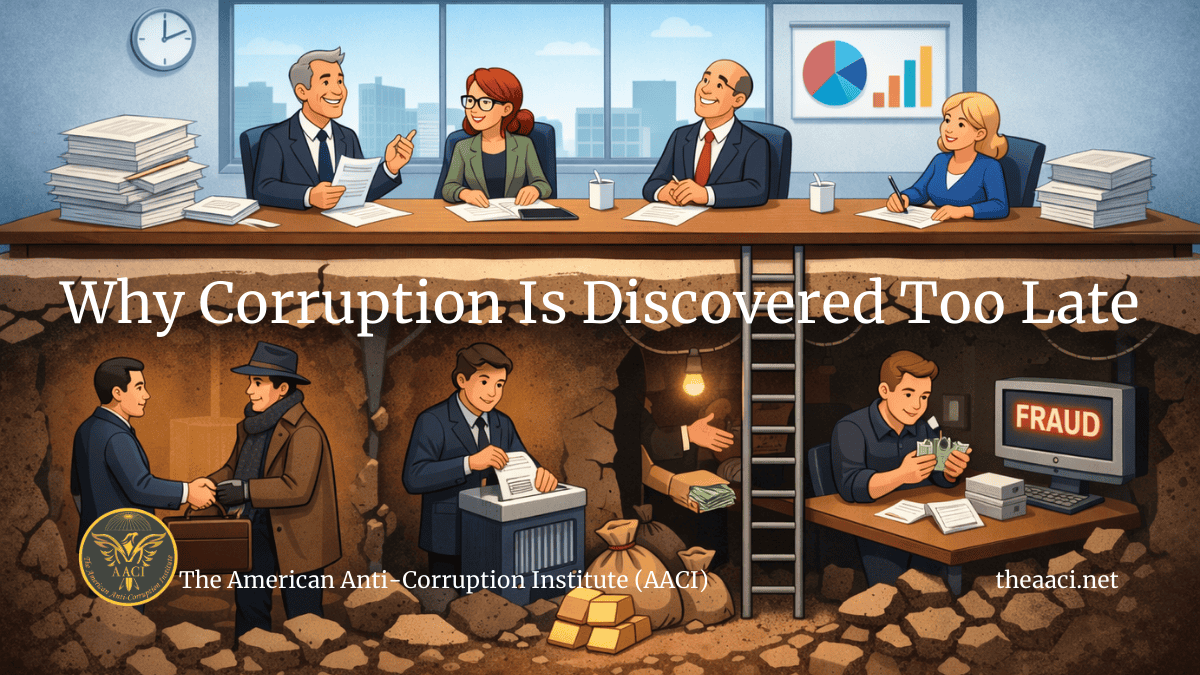
Corruption is often described as a sudden shock or failure no one could have anticipated. This narrative is convenient, but rarely accurate. In most institutions, corruption is not discovered late because it develops invisibly; it is missed early because signals are misunderstood, dismissed, avoided, or deprioritized.
Across sectors, post-incident reviews show warning signs appeared well before exposure. These were not always illegal or dramatic, but they were persistent and ran counter to good governance. The core issue is not a lack of information, but poor interpretation and response.
The Illusion Of Surprise
When corruption becomes public, institutions often express genuine astonishment. However, this sense of surprise is usually the result of retrospective framing rather than objective reality. Internal discussions, audit observations, external auditor’s management letter, compliance reports, and operational anomalies often contain fragments of the truth long before misconduct is formally identified.
Decision makers often interpret silence as assurance that everything is working as planned, and the absence of formal findings is treated as evidence of internal control effectiveness. Over time, this creates an illusion of stability that discourages deeper inquiry and reinforces the belief that existing systems are sufficient, appropriate, and meet our operations and administrative needs.
Early Warning Signs Are Rarely Invisible
In many cases, the indicators that precede corruption are subtle but consistent. Repeated management overrides of internal controls, informal decision channels, resistance to challenge, unexplained urgency in approvals, and chronic reliance on a small circle of trusted individuals are all signals that merit attention. Individually, these issues may appear manageable or routine. Collectively, they suggest a weakening of governance discipline.
These signals are reframed as operational pressures or personality differences. If used repeatedly to avoid scrutiny, such explanations normalize problematic patterns.
Governance Choices Shape Discovery Timing
Delayed discovery is not merely a compliance failure. It is a governance outcome. Boards, regulators, and senior management determine which questions are asked, which reports are interrogated, and which explanations are accepted without further examination.
When oversight focuses on formal compliance instead of decision-making quality, early warning signs are often ignored rather than escalated. Governance bodies may take comfort in the existence of policies and procedures, while paying insufficient attention to how they are actually applied in practice. As a result, attention shifts away from judgment and toward paperwork.
Internal Control Exists, But Judgment Fails
Most institutions that experience corruption have internal control frameworks in place. Policies are documented, procedures are approved, and reporting lines are clearly defined. Yet internal control does not operate in isolation. The effectiveness of internal control, including control activities, depends on the competence of those who interpret results, evaluate exceptions, and decide whether to escalate.
A control exception does not speak for itself. It requires judgment to assess its significance, context, and implications. When decision-makers lack the ability or confidence to interpret weak signals, internal control becomes ceremonial rather than protective.
Why Escalation Rarely Happens Early
Early escalation is uncomfortable, as it becomes part of the status quo mindset. It creates records, triggers accountability, and disrupts narratives of stability and competence. As a result, institutions often defer action until concerns become unavoidable. This deferral is rarely explicit. It is embedded in language that emphasizes proportionality, context, or the need for additional information.
Over time, hesitation becomes a habit. The threshold for action rises, and only overt misconduct is deemed worthy of intervention. By then, the cost of response is significantly higher, both institutionally and reputationally.
Late Discovery Becomes Normalized
Accepting late discovery as normal perpetuates the cycle. Each case is viewed as an anomaly, focusing on procedure rather than decision competence.
This normalization is dangerous because it shifts responsibility away from governance and toward circumstance. It also limits institutional learning, as the same patterns reappear in different forms across time.
What Timely Discovery Actually Requires
Timely discovery requires more than additional controls or enhanced reporting. It requires decision-makers who can recognize emerging risk, question comfortable assumptions, and act before certainty is complete. This capacity is neither intuitive nor guaranteed by seniority.
Institutions that detect corruption earlier tend to place greater emphasis on applied judgment, critical challenge, and the ability to assess risk under pressure. They recognize that governance effectiveness depends as much on competence as it does on structure.
Where Structured Competence Verification Fits
Some institutions have begun to address this gap by introducing structured mechanisms to verify anti-corruption decision-making competence, rather than relying solely on experience or awareness programs. Frameworks such as The AACI’s Certified Anti-Corruption Manager (CACM)reflect this approach by assessing how decision-makers apply anti-corruption principles in realistic governance contexts.
The relevance of such mechanisms lies not in credentialing, but in verification and application.
Delayed Discovery Is A Governance Outcome
Corruption is discovered too late because institutions allow it to be. Early detection is not primarily a technological or regulatory challenge. It is a governance challenge rooted in how competence is understood, tested, and relied upon.
In summary, institutions discover corruption late due to governance shortcomings, particularly in how decision-making competence is prioritized, assessed, and maintained. Improving the quality and rigor of governance is essential for timely detection. Recognizing and acting on early warning signs requires focused attention and a commitment to ongoing evaluation.
Note
The following are principles two and three of the Ten Principles of Fighting Corruption at The AACI;
- Effective internal control
- Effective and good governance