Mike J. Masoud
January 13, 2026
The board of directors, or its equivalent in the public and non-profit sectors, carries a legal and fiduciary responsibility to protect the organization’s assets from abuse, misuse, and loss. It is equally responsible for safeguarding operations, reputation, and stakeholder value from fraud and corruption. Serious leadership accepts an uncomfortable but indisputable fact: corruption is not an ethical anomaly. It is a business risk.
That risk is neither static nor uniform. It varies across organizations, even within the same sector. It evolves over time within the same institution. For this reason alone, the chairman of the board and the chief executive officer must be capable of answering, regularly and without illusion, a question most leaders avoid confronting honestly:
Are the corruption risks in this organization high, medium, or low?
Not in theory.
Not in general.
But across every unit, department, and operational activity.
Yet this article is not about whether leaders ask that question. It is about whether they are competent to answer it.
When incompetence becomes a governance risk
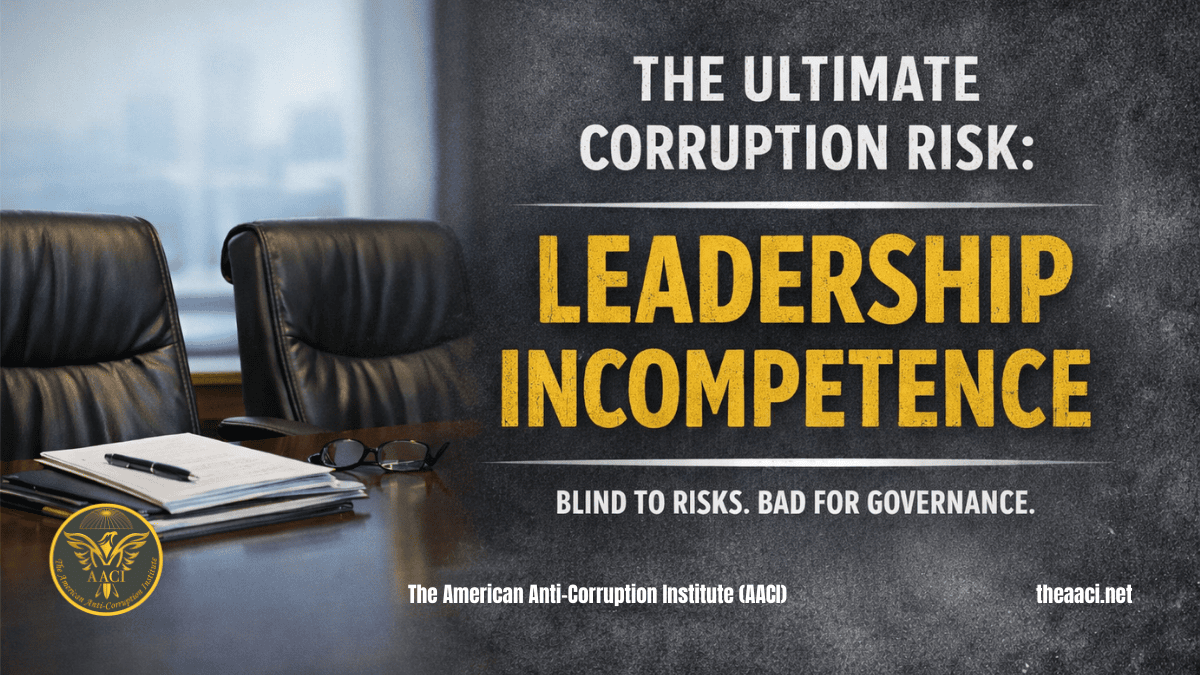
The recognition of corruption risks does not depend solely on exposure. It depends on a far more dangerous variable: the decision-maker’s risk of incompetence.
One cannot see what one does not know.
One cannot assess what one is untrained to understand.
The higher the decision-maker’s incompetence risk, the greater the probability of a distorted corruption-risk assessment. This is not a personal indictment. It is a structural reality. Anti-corruption competence is not optional. It is not symbolic. And it is not delegable.
A chief executive with weak anti-corruption competence cannot rely on subordinates to compensate for that weakness. Delegation does not cure incompetence. It multiplies it.
When leaders depend on others to identify risks they themselves cannot comprehend, they do not reduce exposure. They institutionalise it.
The illusion of protection through governance structures
Legislatures and regulators attempt to ensure that board members meet minimum competence thresholds. Those charged with governance are expected to ensure that the chief executive and senior management possess the capability to identify, assess, evaluate, and manage corruption risks continuously.
Yet regulatory thresholds do not create real competence. They define eligibility, not mastery. Competence remains a leadership obligation, not a regulatory gift. Boards and executives who wait for regulation to make them capable have already failed their governance duty.
The American Anti-Corruption Institute defines competence as the ability to perform a particular job or task with sufficient skill, knowledge, and experience (1). In the context of corruption prevention, this definition carries a sharper meaning. It is not about knowing policies. It is about understanding where corruption hides, how it adapts, and why formal controls often fail silently.
Compliance frameworks can exist without competence.
Controls can function without insight.
Dashboards can glow green while risk deepens.
Corruption prevention begins with self-exposure
Corruption prevention depends directly on leadership’s anti-corruption competence. Not on codes of conduct. Not on ethics committees. Not on certifications displayed in annual reports. On competence.
An organization cannot reduce corruption risks to acceptable levels if its leaders cannot accurately recognize them. The most dangerous exposure is not external pressure. It is internal blindness.
True corruption prevention, therefore, begins with an act of leadership courage that few are willing to perform:
the recognition of one’s own incompetence.
Until leaders are prepared to confront that reality, corruption will remain not merely a criminal issue but a governance failure.
Institutions do not collapse first because criminals act.
They collapse first because leaders believe they are qualified to judge risks they were never trained to understand.
That belief is the ultimate corruption risk.
Further Readings
(1) Standard on Fighting Corruption 200: Competence, https://www.theaaci.net/Standard-on-Fighting-Corruption-200-Competence/ .Accessed on January 13, 2026.