Why Concentrated Authority, Unchecked Access, and Poor Task Separation Create Direct Openings for Fraud and Corruption
Technical Staff | April 7, 2026
Segregation of duties is not an administrative luxury. In fact, it is one of the clearest protections an institution can establish against fraud, corruption, concealment, and manipulation.
When too much authority is concentrated in one person, a division, or an isolated affiliate far from audit or independent verification — or when incompatible duties are allowed to sit too close together — the institution creates an opening that dishonest individuals can exploit and permissive or incautious managers can rationalize. That opening does not remain theoretical for long. It becomes an operational risk.
When Tasks Concentrate, Risk Expands
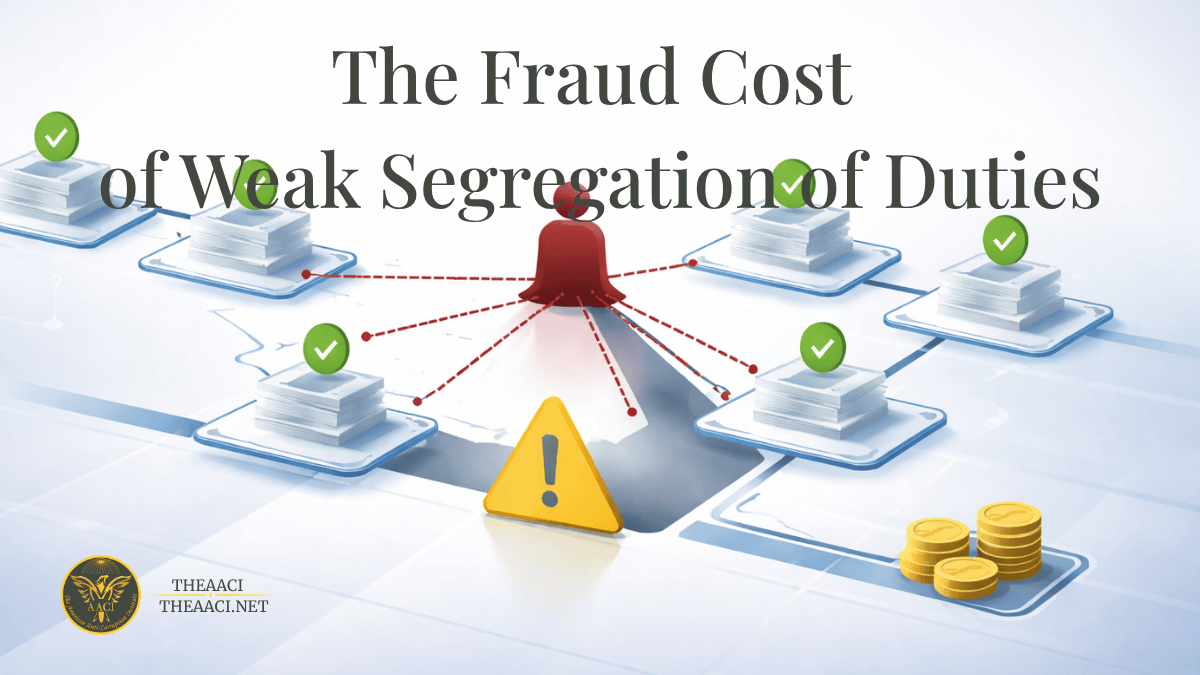
An effective internal control does not allow one employee to initiate, approve, execute, record, maintain custody, and reconcile the same transaction stream without effective independent review. When those tasks are concentrated, the opportunity to commit and conceal wrongdoing expands sharply. Fraud becomes easier to execute, harder to detect, and more likely to persist over time.
Unfortunately, many organizations know this in theory and still fail in practice. They rely on trust, staffing limitations, familiarity, seniority, or operational convenience to justify weak task separation. That is not management — it is exposure to risk. Weak segregation of duties is often defended as a temporary compromise, but temporary compromises have a habit of becoming routine weaknesses. Once normalized, they stop attracting attention. That is when the real damage begins.
The Fraud Cost Goes Beyond Stolen Money
The fraud cost is not limited to the amount stolen. Weak segregation of duties can distort financial reporting, weaken accountability, compromise procurement integrity, undermine confidence in management, and expose boards to failures they should have identified earlier.
It can also undermine investigations in ways that are often underestimated. The same control weakness that enables misconduct frequently shapes, delays, or obscures the records surrounding it. By the time an investigation begins, the audit trail may already reflect the interests of the person who controlled it. This is not a secondary consequence — it is part of how serious fraud sustains itself.
This problem becomes more acute where management override is tolerated, documentation is weak, reconciliation is delayed, or independent review exists only in appearance. Under such conditions, the institution is not merely vulnerable to error. It is vulnerable to organized abuse disguised as a routine process.
The Governance Questions That Matter
Leaders and board members should stop asking whether duties are technically assigned and start asking whether they are meaningfully separated. Who can authorize payments? Who can create or amend vendors? Who can record transactions? Who performs reconciliations? Who reviews exceptions? Who can override the process, and who reviews that override?
These are not narrow accounting questions. They are governance questions.
Segregation of duties is not about mistrusting employees, but about respecting the reality of power, pressure, temptation, and concealment. Serious institutions design processes on the assumption that good intentions are not enough.
For decision-makers who want structured preparation beyond policy familiarity, understanding how fraud risk develops through internal control weakness requires more than titles, routine experience, or broad policy awareness. The CACM self-study pathway offers disciplined, management-focused preparation in internal control, fraud, governance, decision-making, and corruption prevention — built for that purpose.