Mike Masoud | June 20, 2026
A company can have a 100% training completion rate and still be indicted six months later.
That isn’t a coincidence. It’s a predictable outcome of how most anti-corruption training is built.
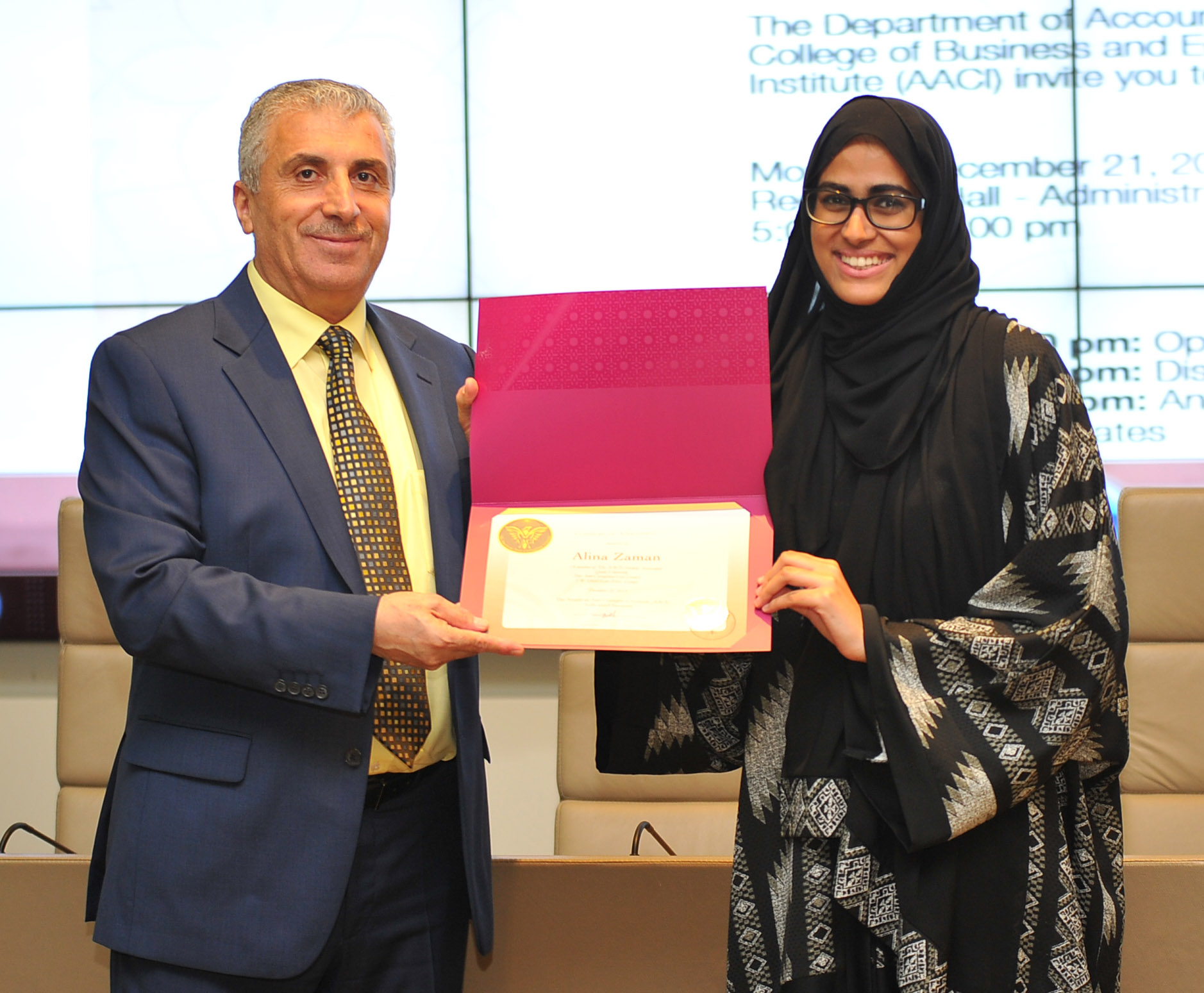
Thousands of organizations require this training every year. Employees attend. Certificates are issued. Policies are acknowledged. And yet corruption scandals continue to emerge in organizations that can produce extensive training records to prove they “did the work.”
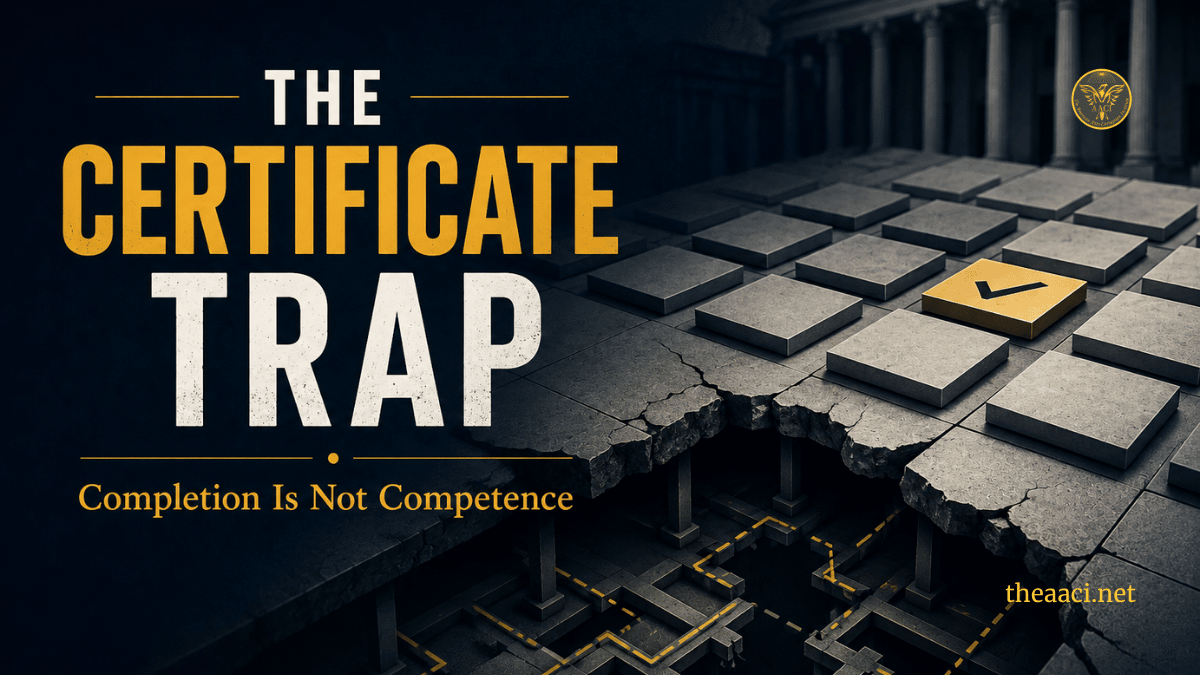
This is the certificate trap: mistaking a completion record for evidence of competence.
The Illusion of Coverage
Many organizations assume that if employees complete anti-corruption training, they are better equipped to prevent corruption. That assumption is misleading.
Attendance does not create competence. A completed training record does not prove that participants can identify corruption risks, exercise sound judgment under pressure, or respond effectively when confronted with a real decision. The certificate becomes a proxy for capability — and a poor one. It tells you who showed up. It tells you nothing about who would actually catch the bribe, flag the conflicted vendor, or push back on a manipulated bid.
Training satisfies the administrative requirement while leaving the actual knowledge gap untouched. That gap is where the next scandal comes from.
One Size Does Not Fit All
Corruption risk is not distributed evenly across an organization, but most training is.
A board member faces different corruption exposure than a procurement manager. An executive carries different responsibilities than an internal auditor. A public official confronts different pressures than a compliance officer. Board members need to understand oversight failures, accountability gaps, and governance-level exposure. Procurement teams need to recognize bid manipulation, conflicts of interest, and vendor collusion. Executives need to understand how incentive structures, resource allocation, and culture quietly create the conditions for misconduct.
Deliver the same generic module to all of them, and you get the same generic result: a room full of certificates and no one specifically equipped for the risks in front of them.
Corruption Prevention Is a Management Responsibility
Most anti-corruption programs are built around employee awareness. Far fewer are built around the people who actually exercise authority over decisions, budgets, and oversight.
That’s a significant blind spot. Corruption prevention depends on management decisions, governance practices, internal control effectiveness, and the quality of oversight exercised at the top. The people directing an organization have the greatest power to reduce corruption exposure — or to unintentionally create it through the incentives they set and the oversight they neglect.
Training that ignores this leaves decision-makers undertrained in exactly the area where their judgment matters most.
This is where decision-maker readiness becomes the real objective — not as a slogan, but as a measurable standard: can the people with authority actually identify, assess, and respond to corruption risk inside their own area of responsibility? Readiness is not the opposite of a certificate. It’s what a certificate should have been measuring all along.
The Cost of Falling Into the Trap
The certificate trap doesn’t just fail to help — it actively misleads. Organizations conclude that corruption risk is “addressed” because the training boxes are checked. Meanwhile, the real weaknesses — in governance, oversight, internal control, whistleblowing channels, accountability — remain exactly where they were.
Training becomes evidence of activity rather than evidence of effectiveness. And the gap between the two is precisely where corruption finds room to operate.
From the Certificate Trap to Decision-Maker Readiness
Escaping the certificate trap requires a different design standard. Three things separate training built for readiness from training built for compliance optics:
1. It is built around the role, not the audience size.
Effective programs map content to the specific decisions a role actually makes — bid evaluation for procurement, resource allocation for executives, oversight questions for boards — rather than delivering one module to everyone for administrative convenience.
2. It tests judgment, not recall.
Readiness-based training puts participants inside realistic decision points — a pressured vendor relationship, an ambiguous gift, a board-level red flag — and evaluates how they respond, not whether they can recognize a definition on a multiple-choice quiz.
3. It ties back to the organization’s actual risk profile.
Training content should reflect the specific corruption exposures identified in the organization’s own risk assessment, not a generic library of hypothetical scenarios that could apply to any company anywhere.
The Question Organizations Should Be Asking
Most organizations ask: “How many employees completed anti-corruption training?”
The more important question is: “Have our decision-makers developed the readiness to identify, assess, deter, prevent, detect, and respond to corruption risk?”
The first question can be answered by a spreadsheet. The second can only be answered by testing judgment under realistic pressure — and it’s the only one that actually predicts whether your organization is protected.
Generic training fills the certificate trap with paperwork. Decision-maker readiness is what replaces it.
Published June 20, 2026.
© 2026 Mike Masoud, Senior Director of The American Anti-Corruption Institute (AACI) in the Middle East and Africa. Published by The American Anti-Corruption Institute under a non-exclusive license.