Mike Masoud | April 7, 2026
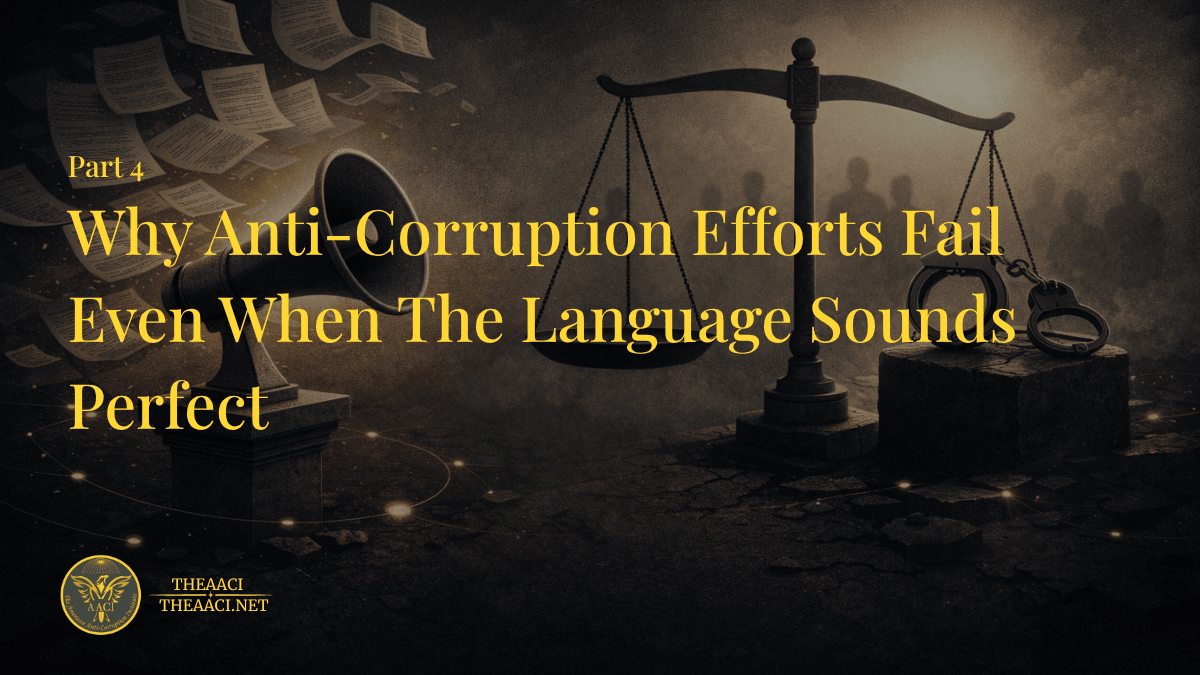
This is Part 4 of a five-part series on where countries should start when corruption is widespread across institutions and economic sectors. If Part 1 argued that a country must define corruption clearly, Part 2 argued that it must build the right institutional foundations, and Part 3 argued that it must start with diagnosis and prioritization, this part addresses a harder problem: why do anti-corruption efforts still fail even when the language sounds right? The answer is not mysterious. Many anti-corruption efforts fail because governments confuse declarations with deterrence, institutions with effectiveness, and strategy documents with measurable results (OECD, 2020).
The first reason is performative reform. Some governments create anti-corruption bodies, adopt strategies, publish commitments, and speak the language of transparency while leaving the real structure of abuse untouched. The problem is not the absence of words. It is the absence of restraint. The OECD’s monitoring of anti‑corruption reforms in Armenia described many state actions during one period as widely perceived as largely cosmetic and as an imitation of a genuine anti‑corruption drive, noting that the government struggled to convince society of the seriousness of its efforts (OECD, 2018). That is a devastating but familiar pattern. Citizens do not trust anti-corruption campaigns when they are loudly publicized but enforced selectively.
The second reason is selective enforcement. A state cannot fight corruption seriously when anti-corruption laws are used mainly against political opponents, critics, or weaker actors while those close to power remain protected. OECD anti‑corruption monitoring in Eastern Europe and Central Asia has stressed that effective anti‑corruption enforcement requires proportionate, dissuasive sanctions applied without regard to the offender’s political, economic, or social standing (OECD, 2020). Once enforcement becomes selective, anti-corruption ceases to be a system of justice and becomes a tool of political management.
The third reason is state capture. Ordinary corruption is dangerous enough, but state capture is more destructive because it distorts the rules themselves. The World Bank’s work on state capture explains how powerful firms and actors may shape laws, policies, and regulations to their own advantage through illicit and non-transparent influence (Hellman, Jones and Kaufmann, 2000). Under those conditions, anti-corruption failure is not merely the result of weak implementation. It is built into the governing structure. A captured state can speak the language of reform while protecting the incentives, networks, and legal distortions that keep corruption alive.
The fourth reason is the collapse of public trust and accountability channels. Where media are restricted, civil society is weakened, and oversight bodies are politicized, anti-corruption language may continue long after anti-corruption capacity has been hollowed out. Bangladesh offers a warning here. Freedom House has highlighted that anti‑corruption efforts in Bangladesh have been weakened by politicized law enforcement, subversion of the judicial process, and restrictions on independent scrutiny. Human Rights Watch has argued that meaningful reform requires changes in the justice system, public administration, police, and the anti‑corruption commission itself (Freedom House, 2025; Human Rights Watch, 2025). The lesson is clear. Anti-corruption promises cannot survive on rhetoric once the institutions of accountability lose credibility.
The fifth reason is donor and lender complacency. External support can help reform, but poorly conditioned support can also preserve dysfunction. The IMF explains that poor governance can create more incentives and opportunities for corruption and can undermine public trust, market integrity, and development (IMF, n.d.). The World Bank’s Lebanon Reform, Recovery and Reconstruction Framework made a related point after the Beirut port explosion, warning that Lebanon needed to break the capture of political elites over state institutions and adopt a governance model built on transparency, accountability, and inclusion, and that international support for recovery would not be sustained or expanded without meaningful progress on those reforms (World Bank, 2020). External money does not become clean merely because it arrives with good intentions. When assistance enters a system marked by impunity, opacity, and weak accountability, it can unintentionally help sustain the very order it claims to improve.
The sixth reason is that corruption is self-reinforcing. The World Bank has noted that corruption can operate as a self-reinforcing trap: when corruption is expected, tolerated, or normalized, the incentives to resist it weaken, while those to participate increase (Stephenson, 2020). This is why anti‑corruption reform cannot rely only on moral appeals. It must alter incentives, raise the probability of detection, reduce discretion where abuse is common, strengthen competence, and make accountability visible—steps that the World Bank’s analysis of “corruption as a self‑reinforcing trap” suggests are essential for effective reform (Stephenson, 2020).
So why do anti-corruption efforts fail even when the language sounds perfect? Because polished language is cheap. Genuine anti-corruption is expensive. It demands that powerful interests lose room to operate. It demands that enforcement stop being selective. It demands that citizens, journalists, courts, oversight bodies, and honest officials gain real capacity to question power. It demands that external supporters stop confusing engagement with accountability.
A country does not fail to fight corruption because it lacks vocabulary. It fails because, in many contexts, the system has evolved to absorb reform language while limiting its actual implementation.
Next Tuesday, Part 5 — What Serious Countries Should Do If They Want Citizens To Feel The Results — will set out the practical recommendations, responsibilities, and measurable actions needed if anti-corruption is to become visible, credible, and real.
References
Freedom House (2025) Bangladesh: Freedom in the World 2025 Country Report. Available at: https://freedomhouse.org/country/bangladesh/freedom-world/2025 (Accessed: 6 April 2026).
Hellman, J.S., Jones, G. and Kaufmann, D. (2000) State Capture, Corruption, and Influence in Transition. Available at: https://openknowledge.worldbank.org/entities/publication/e7ff924b-ec49-5019-94ce-75431ee93337 (Accessed: 6 April 2026).
Human Rights Watch (2025) After the Monsoon Revolution: A Roadmap to Lasting Security Sector Reform in Bangladesh. Available at: https://www.hrw.org/report/2025/01/27/after-monsoon-revolution/roadmap-lasting-security-sector-reform-bangladesh(Accessed: 6 April 2026).
International Monetary Fund (IMF) (n.d.) The IMF and Good Governance. Available at: https://www.imf.org/en/about/factsheets/sheets/2023/the-imf-and-good-governance (Accessed: 6 April 2026).
OECD (2018) Anti-Corruption Reforms in Armenia. Available at: https://www.oecd.org/content/dam/oecd/en/publications/reports/2018/09/anti-corruption-reforms-in-armenia_42f67531/4b8baa87-en.pdf(Accessed: 6 April 2026).
OECD (2020) OECD Public Integrity Handbook. Available at: https://www.oecd.org/en/publications/oecd-public-integrity-handbook_ac8ed8e8-en.html (Accessed: 6 April 2026).
OECD (2020) Anti-Corruption Reforms in Eastern Europe and Central Asia. Available at: https://www.oecd.org/content/dam/oecd/en/publications/reports/2020/09/anti-corruption-reforms-in-eastern-europe-and-central-asia_b433c079/9e621f2f-en.pdf(Accessed: 6 April 2026).
Stephenson, M.C. (2020) Corruption as a Self-Reinforcing Trap: Implications for Reform Strategy. Available at: https://openknowledge.worldbank.org/server/api/core/bitstreams/315ebb89-420f-5a49-b6e6-d70f5807c9bf/content(Accessed: 6 April 2026).
World Bank (2020) Lebanon Reform, Recovery and Reconstruction Framework (3RF). Available at: https://documents1.worldbank.org/curated/en/948021607068524180/pdf/Lebanon-Reform-Recovery-and-Reconstruction-Framework-3RF.pdf(Accessed: 6 April 2026).