Mike J. Masoud
March 17, 2026
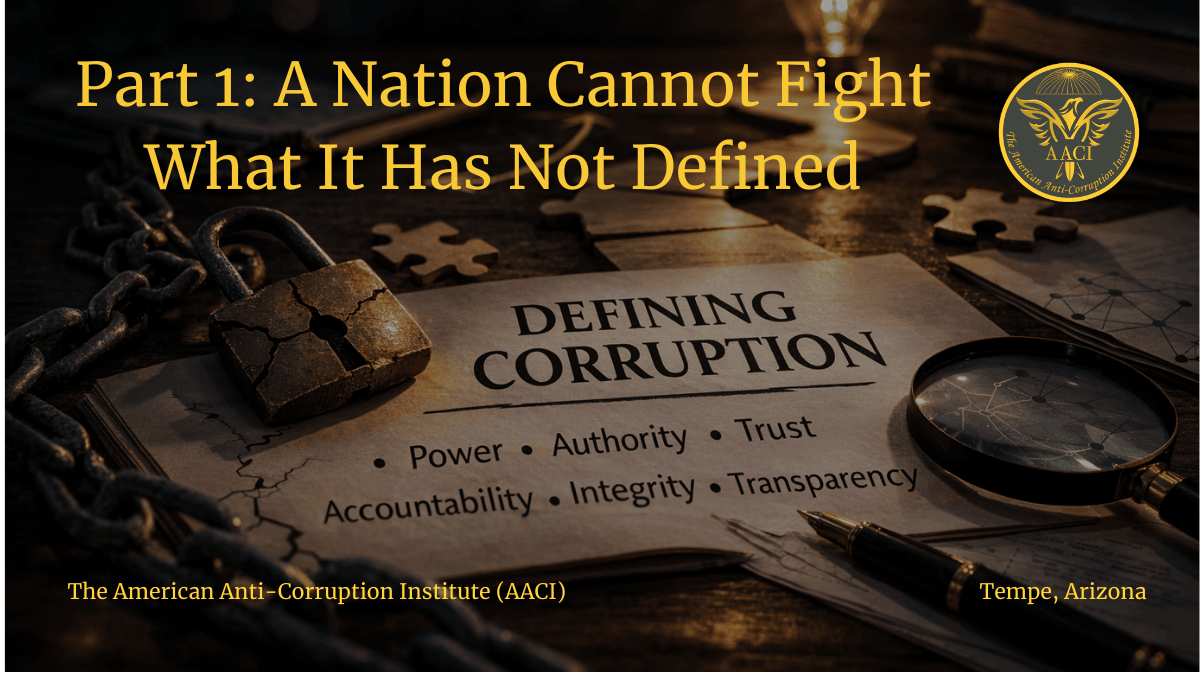
This is Part 1 of a five-part series on where countries should start when corruption is widespread across institutions and economic sectors. This part addresses a basic but neglected reality: no country can fight corruption intelligently unless it first defines what it is trying to fight, how it appears in practice, and why citizens should care. That is not an academic detail. It determines whether anti-corruption reform becomes a serious national effort or collapses into slogans, selective enforcement, and political theater (Exam Unit, n.d.a; OECD, 2020).
A country does not fight corruption merely by announcing a strategy, creating a commission, or passing a law. It fights corruption when those charged with governance, public officials, employees, citizens, and other stakeholders engage in a continuous, results-oriented process to provide reasonable assurance that entrusted power is not abused for private gain. The AACI defines fighting corruption as a process effected by those charged with governance, employees, citizens, and other stakeholders to provide reasonable assurance that those entrusted with power do not abuse it for private gain. Under The AACI framework, that process is holistic, continuous, results-oriented, multidisciplinary, and relevant to all economic sectors rather than confined to criminal prosecution alone (Exam Unit, n.d.a). The AACI also defines corruption as “Abuse of power or perceived power or entrusted authority for direct or indirect private monetary or non-monetary gain” (Exam Unit, 2025, p. 203).
This is where many countries fail before they begin. They speak about corruption as if everyone already agrees on what it means. They do not. Local law matters because legal systems define offenses, powers, penalties, and procedures. Yet law alone is not enough. A country may criminalize some forms of bribery while tolerating conflicts of interest, patronage, abuse of discretion, opaque procurement, or politically protected impunity. Building on the broader scope of UNCAC, one can distinguish between legal corruption, institutional corruption, and the broader abuse of entrusted power. That distinction is an analytical lens used in this series, not formal UNODC terminology. Without that distinction, governments can manipulate narrow legal definitions and still claim progress (United Nations Office on Drugs and Crime, n.d.a).
The United Nations Convention against Corruption supports a broader and more disciplined understanding of the problem. UNCAC is the only legally binding universal anti-corruption instrument, and its design is not limited to punishing bribery after the fact. Its framework emphasizes preventive measures, criminalization and law enforcement, international cooperation, and asset recovery. That matters because corruption is not merely a criminal justice issue. It is also a governance problem, a public administration problem, an economic problem, and a national trust problem (United Nations Office on Drugs and Crime, n.d.a; United Nations Office on Drugs and Crime, n.d.b).
No serious country should assume that the same anti-corruption starting point works everywhere. Corruption risk varies by institutional maturity, sector structure, regulatory quality, enforcement culture, social tolerance, and the degree of state capture. What is concentrated in procurement in one country may be embedded in licensing, customs, public employment, state-owned enterprises, or judicial interference in another. That is why the starting point must be diagnosis, not imitation. Countries do not need perfect national consensus, but they do need a sufficiently clear legal, institutional, and operational understanding of the conduct they intend to deter, prevent, detect, and correct (OECD, 2020; United Nations Office on Drugs and Crime, n.d.b).
As set out in the OECD’s public integrity framework, including the OECD Public Integrity Handbook, public integrity requires a whole-of-government and whole-of-society approach rather than isolated or ad hoc measures. The Handbook explains that it provides guidance for implementing the OECD public integrity framework, while OECD materials make clear that the approach moved away from ad hoc integrity policies toward a context-dependent and risk-based model (OECD, n.d.; OECD, 2020). That insight is critical. A nation cannot credibly claim to fight corruption if it leaves the issue to a single ministry, a single commission, or a single annual speech. It must define the problem in a way that allows the entire system to respond: lawmakers, courts, regulators, auditors, civil society, the media, the private sector, and citizens. Without that shared operational clarity, enforcement becomes selective, public messaging becomes hollow, and reform becomes vulnerable to politics.
The AACI’s Standards on Fighting Corruption reinforce this practical view. The standards do not treat anti-corruption as a narrow legal exercise. They frame it as a structured discipline requiring competence, deterrence, transparency, whistleblowing, and other measurable safeguards that can operate across institutions and sectors (Exam Unit, n.d.b). That matters because a country cannot define corruption seriously unless it also defines the standards, controls, and expectations that are meant to lower corruption risk in practice.
The first question, then, is not whether a country says it opposes corruption. Almost every country says that. The first question is whether the country has identified what corruption means in its own legal and institutional reality, where it is most damaging, how it survives, and what success would actually look like to ordinary citizens. A nation cannot fight what it has not defined. It can only pretend to (Exam Unit, n.d.a; Exam Unit, n.d.b; United Nations Office on Drugs and Crime, n.d.a).
Next Tuesday, March 24, 2026, Part 2 — Why No Country Can Fight Corruption Without the Right Institutional Foundations — will examine why the rule of law, accountability, judicial independence and effectiveness, and competence must exist before any national anti-corruption strategy can be taken seriously.
References
Exam Unit (n.d.a) Principles of Fighting Corruption. Available at: https://www.theaaci.net/Principles-of-Fighting-Corruption (Accessed: 15 March 2026).
Exam Unit (n.d.b) Standards on Fighting Corruption (SFCs). Available at: https://www.theaaci.net/Standards-on-Fighting-Corruption-%28SFCs%29 (Accessed: 15 March 2026).
Exam Unit (2025) ‘Fraud and Corruption’, Certified Anti-Corruption Manager (CACM) Review Textbook, 2025 edn. United States of America: The Exam Unit of The American Anti-Corruption Institute LLC, 15 January, p. 203.
OECD (n.d.) Public Integrity. Available at: https://www.oecd.org/en/topics/public-integrity.html (Accessed: 15 March 2026).
OECD (2020) OECD Public Integrity Handbook. Available at: https://www.oecd.org/en/publications/oecd-public-integrity-handbook_ac8ed8e8-en.html (Accessed: 15 March 2026).
United Nations Office on Drugs and Crime (n.d.a) UNCAC – United Nations Convention Against Corruption. Available at: https://www.unodc.org/corruption/en/uncac/index.html (Accessed: 15 March 2026).
United Nations Office on Drugs and Crime (n.d.b) Learn About UNCAC. Available at: https://www.unodc.org/corruption/en/uncac/learn-about-uncac.html (Accessed: 15 March 2026).