
Mike J. Masoud
December 1, 2025
A judiciary rarely announces its decline. There is no siren, no headline that tells people the courts are slipping away from them. The shift happens slowly. A strange ruling here, an unexplained delay there. A judge was removed for reasons no one believes. A prosecutor pressured to “rethink” a case. At first, people shrug. They hope it is temporary. They give the system the benefit of the doubt.
But a moment eventually arrives—quiet, personal, unmistakable—when the public stops believing the courts stand above power. That moment is the one that matters.
I argue that:
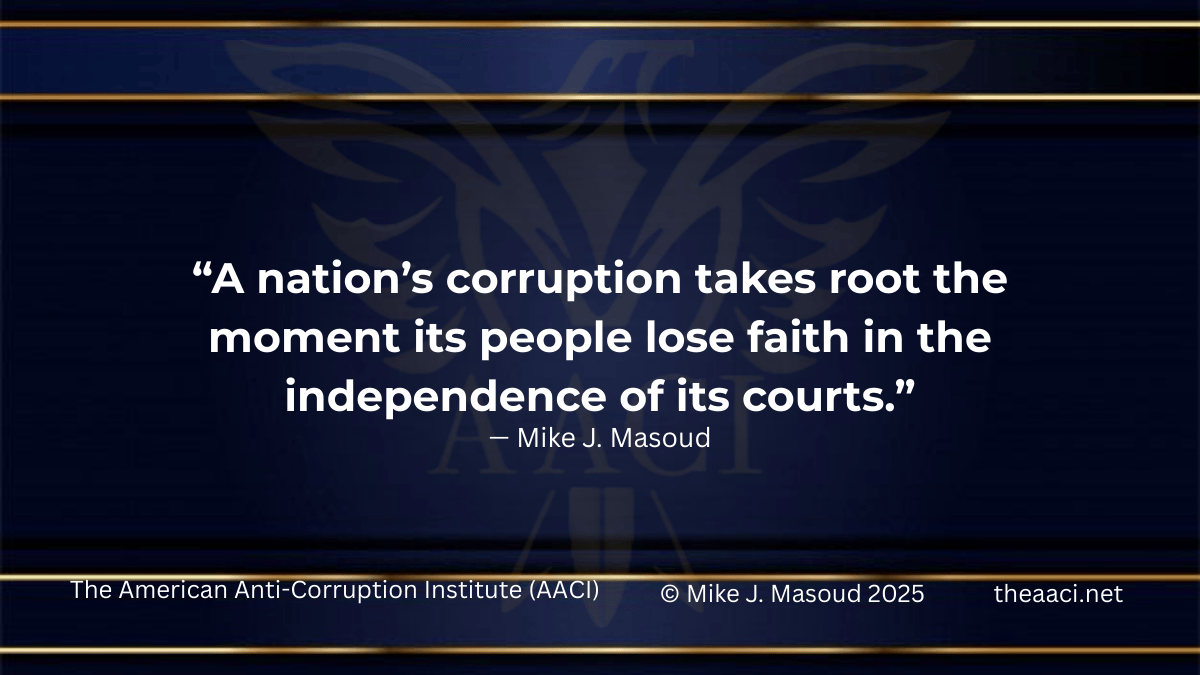
“A nation’s corruption takes root the moment its people lose faith in the independence of its courts.” — Mike J. Masoud
Because once that faith disappears, everything else begins to unravel.
Citizens start behaving differently. They avoid filing complaints because they assume nothing will come of it. Businesses look for political protection rather than legal certainty. Honest officials lose confidence that wrongdoing will be punished. And those who rely on influence rather than integrity sense an opportunity. They move quickly because they know the risk is gone.
That is how corruption grows—not through one spectacular act, but through thousands of small decisions made by people convinced the courts can no longer protect them.
The judiciary is society’s final safety net. When it weakens, every other institution weakens with it. Internal control becomes a ritual. Oversight bodies lose credibility. Laws still exist on paper, but they lose meaning in practice. You feel the consequences everywhere: in public procurement, in policing, in banking, in elections, in basic services.
The tragedy is not only institutional; it is emotional. When people believe courts defend the powerful rather than the public, something essential breaks inside them. It becomes harder to hope. Harder to trust. Harder to believe that change is possible. That cynicism is the real cost of a compromised judiciary, and it is far more damaging than any single act of corruption.
Fixing this damage is brutally difficult. Restoring institutions is technical. Restoring public belief is personal. It requires openness, consequences, and a genuine willingness to confront those who bent the system in the first place.
Judicial independence is not an abstract principle or a legal requirement tucked into a constitution. It is a nation’s backbone. Strip it away, and corruption does not just increase; it becomes inevitable and, in all likelihood, the norm.
#JudicialIndependence #RuleOfLaw #GovernanceReform #FightCorruption #PublicTrust