Mike J. Masoud
March 24, 2026
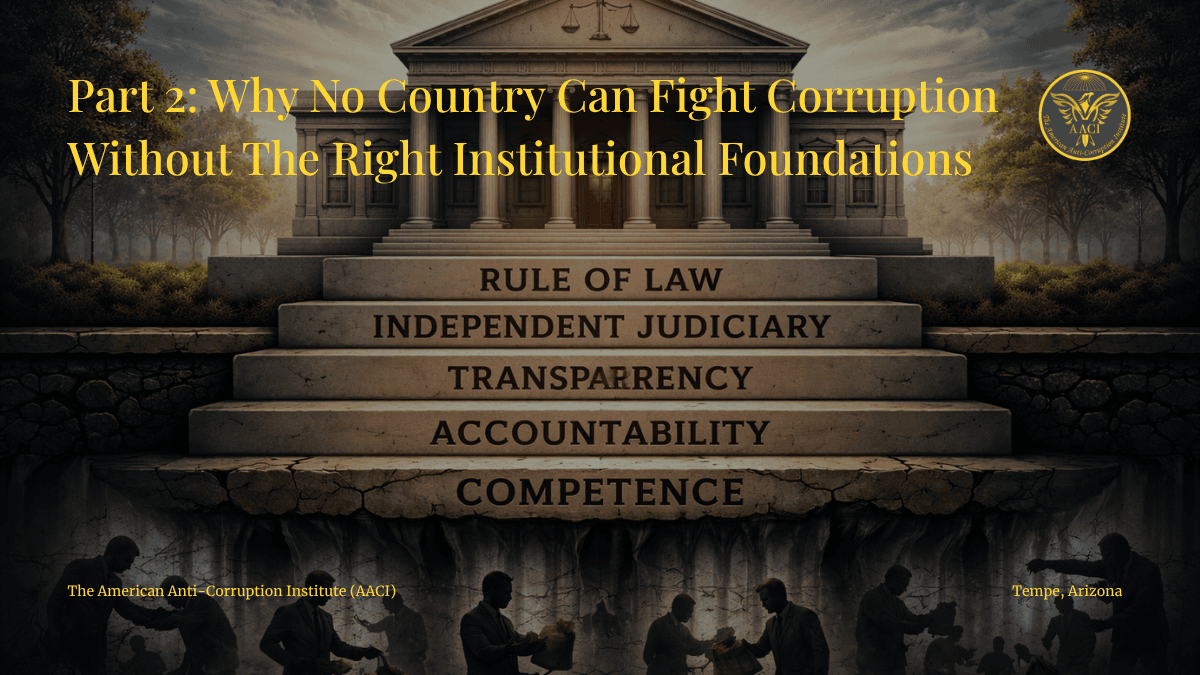
This is Part 2 of a five-part series on where countries should start when corruption is widespread across institutions and economic sectors. This part examines the institutional foundations without which anti-corruption reform becomes political theater rather than measurable national progress. If Part 1 established that a country must define corruption clearly, Part 2 makes the next point unavoidable: no country can fight corruption seriously when law is weak, governance is poor, power is not matched by accountability, competence is compromised, transparency is limited, and the judiciary lacks independence or effectiveness (Exam Unit, n.d.a; Exam Unit, n.d.b; Exam Unit, n.d.c).
The AACI’s Ten Principles of Fighting Corruption are direct on this issue. They identify the pervasiveness of the rule of law, effective and good governance, an independent and effective judiciary, and power and accountability as core principles for bringing corruption down to acceptable lows. That is not decorative language. It is a warning. A country may announce a national anti-corruption strategy, create an anti-corruption agency, and deliver speeches about integrity. Yet if law is applied selectively, public power is exercised without real accountability, and courts are weak or politically constrained, the state is not fighting corruption. It is managing appearances (Exam Unit, n.d.a).
Competence belongs inside this foundation, not at its margins. The AACI’s Standard on Fighting Corruption 200 states that competence applies to those charged with governance, decision makers, and employees in all economic sectors, and that selection and promotion should be based on merit rather than nepotism or favoritism (Exam Unit, n.d.b). This matters because incompetence and corruption are often allies. A government filled with unqualified decision makers, politically protected appointees, or weak administrators will not implement anti-corruption reform well, even if it wants to. In many systems, poor competence is not merely a staffing problem. It is part of the corruption problem.
Transparency is equally foundational. The AACI’s Standard on Fighting Corruption 240 treats transparency as the legal ability of stakeholders to obtain timely, sufficient, and appropriate information to make informed decisions. Without that, citizens, journalists, auditors, civil society, markets, and even honest officials are denied the information needed to question, detect, and deter corruption (Exam Unit, n.d.c). Transparency does not eliminate corruption on its own, but opacity protects it.
Hong Kong’s anti-corruption experience remains one of the clearest illustrations of what institutional seriousness looks like. Official ICAC materials describe a period before 1974 in which bribery was rampant in public services, and corruption was especially serious in the police force. The response that followed did not rely solely on moral rhetoric. It combined investigation, prevention, and community education through an institution designed to operate independently and systematically. That model is not mechanically transferable to every country, but it makes a crucial point: corruption declines when institutions are built to enforce, prevent, and educate simultaneously, not when governments merely condemn misconduct in public statements (ICAC, 2024; Government of Hong Kong, 2025).
The opposite lesson appears when institutions are captured, politicized, or hollowed out. Freedom House reported that in Bangladesh, anti-corruption efforts were weakened by politicized law enforcement, subversion of the judicial process, and restrictions on media and civil society that undermined exposure of government corruption. Human Rights Watch later argued that lasting reform required changes in the justice system, public administration, police, and the anti-corruption office itself. The point is not to single out Bangladesh for condemnation. The point is simpler and harder: where accountability mechanisms are politically bent, anti-corruption language can survive long after anti-corruption capacity has collapsed (Freedom House, 2025; Human Rights Watch, 2025).
This is also why state capture is so dangerous. The World Bank’s work on state capture distinguishes it from ordinary administrative corruption by showing how powerful actors can shape the rules of the game themselves. Once that happens, corruption is no longer only a matter of bribery or isolated abuse. It becomes embedded in lawmaking, regulation, and enforcement. Under those conditions, an anti-corruption strategy without institutional reform is little more than theater (Hellman, Jones and Kaufmann, 2000).
A country cannot fight corruption seriously without the right institutional foundations. The rule of law must prevail. Governance must function. Power must be matched by accountability. The judiciary must be effective and independent. Competence must matter. Transparency must be real. Without these foundations, anti-corruption is not a serious national effort. It becomes a managed performance by institutions that are supposed to be checked, restrained, and held accountable.
Next Tuesday, Part 3 — Where Should A Country Start When Corruption Is Widespread? — will examine how a country should sequence action in practice, prioritize high-risk sectors, and pursue early results that citizens can actually see and feel.
References
Exam Unit (n.d.a) Principles of Fighting Corruption. Available at: https://www.theaaci.net/Principles-of-Fighting-Corruption/ (Accessed: 23 March 2026).
Exam Unit (n.d.b) Standard on Fighting Corruption 200: Competence. Available at: https://www.theaaci.net/Standard-on-Fighting-Corruption-200-Competence/ (Accessed: 23 March 2026).
Exam Unit (n.d.c) Standard on Fighting Corruption 240: Transparency. Available at: https://www.theaaci.net/Standard-on-Fighting-Corruption-240-Transparency (Accessed: 23 March 2026).
Freedom House (2025) Bangladesh: Freedom in the World 2025 Country Report. Available at: https://freedomhouse.org/country/bangladesh/freedom-world/2025 (Accessed: 23 March 2026).
Government of Hong Kong (2025) ICAC: Hong Kong The Facts. Available at: https://www.gov.hk/en/about/abouthk/factsheets/docs/icac.pdf (Accessed: 23 March 2026).
Hellman, J.S., Jones, G. and Kaufmann, D. (2000) State Capture, Corruption, and Influence in Transition. Available at: https://openknowledge.worldbank.org/entities/publication/e7ff924b-ec49-5019-94ce-75431ee93337 (Accessed: 23 March 2026).
Human Rights Watch (2025) After the Monsoon Revolution: A Roadmap to Lasting Security Sector Reform in Bangladesh. Available at: https://www.hrw.org/report/2025/01/27/after-monsoon-revolution/roadmap-lasting-security-sector-reform-bangladesh(Accessed: 23 March 2026).
ICAC (2024) Brief History. Available at: https://www.icac.org.hk/en/about/history/index.html (Accessed: 23 March 2026).