
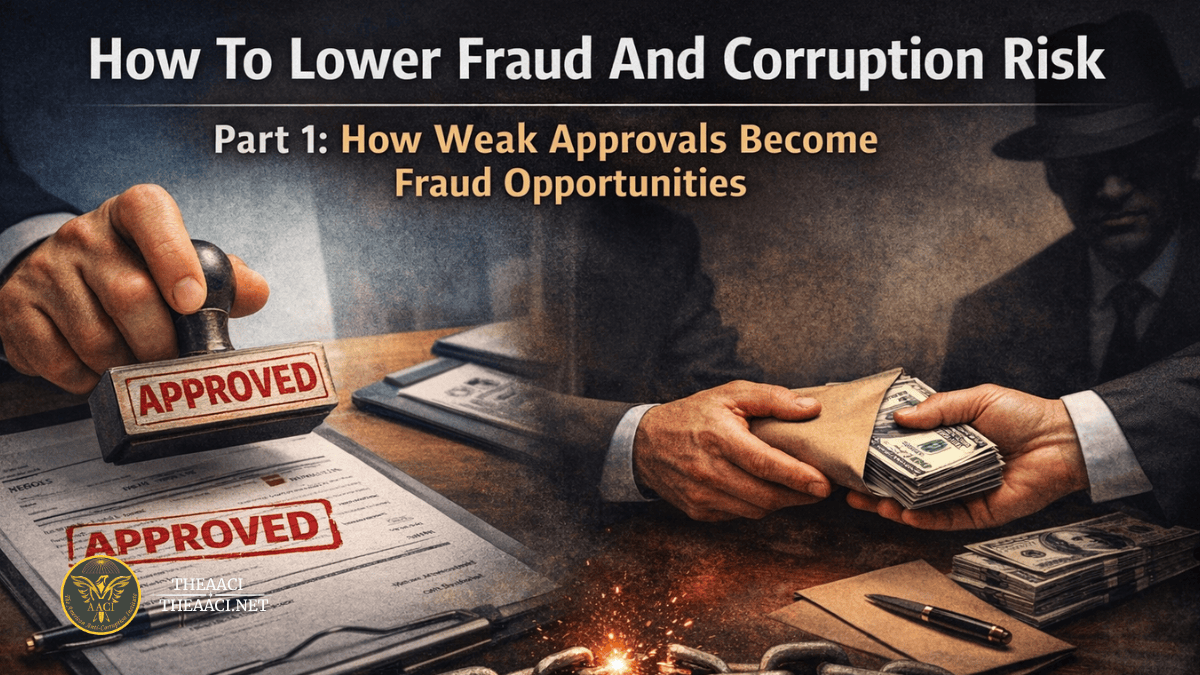
Part 1: How Weak Approvals Become Fraud Opportunities
Technical Staff
April 1, 2026
Approvals are often treated as routine administrative steps. That is a serious error. An approval is not a clerical act. It is a control decision. It reflects whether someone with authority examined the facts, challenged the rationale, weighed the risk, and decided that the transaction, action, or exception should proceed. When that judgment is weak, fraud and corruption do not need to bring the system down. They enter through it.
Most organizations do not collapse because they lack policies. They collapse because apparently ordinary decisions are approved too easily, too quickly, or by people who no longer treat scrutiny as part of their role. A consultant is engaged without proper justification. A payment is processed before due diligence is complete. A senior hire is pushed through despite unresolved concerns. A discount, commission, or contract amendment is approved under pressure because management wants speed, revenue, or silence. That is how exposure grows. Quietly, repeatedly, and without needing a dramatic conspiracy.
Why this matters
Fraud and corruption rarely spring from spectacular moments. They usually take shape inside weak judgment, poor challenge, and casual approval habits. A signature, an email approval, a verbal instruction, or a retroactive exception can become the point at which the organization stops controlling risk and starts enabling it.
This matters because approvals sit everywhere. They affect payments, procurement, hiring, sales incentives, write-offs, expenses, vendor onboarding, third-party retention, journal entries, and contract amendments. If approval quality is poor, the organization may appear controlled while operating in a state of hidden vulnerability.
The real danger is not only that one improper transaction slips through, but that many do. The greater danger is that weak approval behavior becomes normalized. Once that happens, people stop seeing the warning signs. They begin to confuse familiarity with safety, urgency with justification, and authority with legitimacy.
Where the risk usually hides
Weak approvals rarely look weak on the surface. They are usually disguised as efficiency, commercial urgency, management discretion, trust in senior people, or the need to “keep business moving.” That is why they survive.
The risk often hides in vague supporting documents, one-person approvals over sensitive matters, repeated exceptions to normal procedure, incomplete due diligence, approval chains bypassed through informal influence, and after-the-fact regularization of decisions that should never have proceeded in the first place. It also hides the fact that staff stop challenging senior people because questioning them is seen as disloyal, impractical, or career-limiting.
In those conditions, the approval process no longer functions as a safeguard. It becomes a shield for bad judgment and, in some cases, a cover for misconduct.
How it appears in daily work
The early warning signs are usually visible long before an investigation begins.
A finance employee receives an invoice with a vague description and is told to process it because “management already approved it.” A procurement team is pressured to proceed with a vendor before the file is complete. A human resources function is pushed to accelerate a senior appointment even though background concerns remain unresolved. A sales team secures approval for an unusual commission arrangement on the basis that the market is difficult and speed matters. Internal audit later sees the pattern, but by then it is scattered across several functions and buried inside normal business activity.
None of these decisions may look catastrophic when viewed alone. That is exactly why they are dangerous. Fraud and corruption often grow through small approvals that seem explainable in isolation but reveal a serious control weakness when viewed together.
A practical scenario
A regional executive insists that a local consultant must be retained immediately to help secure an important business opportunity. The consultant’s role is described in broad terms. The fee is high. Procurement asks for stronger documentation and more detail on the services to be provided. The executive responds that the delay could damage a major commercial relationship. Finance receives the invoice before due diligence is complete. A senior leader instructs the team to process the payment and sort out the paperwork afterward.
Nothing in that sequence is unusual. That is the problem.
The risk is not limited to whether the consultant is legitimate. The real failure lies in the approval environment itself. Urgency displaced scrutiny, authority weakened the challenge, documentation became secondary, and process became reactive. Once those conditions are tolerated, the organization has already lowered its defenses.
Five practical actions
1. Identify the approvals that carry the highest risk
Not all approvals deserve the same level of attention. Organizations should clearly identify the categories where fraud and corruption risk is naturally higher. These usually include new vendors, consulting arrangements, commissions, discounts, gifts and hospitality, executive expenses, contract amendments, write-offs, manual journal entries, politically sensitive relationships, and senior recruitment decisions.
When all approvals are treated the same, high-risk approvals receive less discipline than they require.
2. Require a written business rationale that can withstand review
No material approval should rely on vague language or verbal comfort. Every significant approval should state what is being approved, why it is necessary, what evidence supports it, who benefits, what risks were considered, and whether the decision involves any exception to normal process.
Words such as “urgent,” “strategic,” “commercially necessary,” or “management decision” are not explanations. They are placeholders where abuse hides.
3. Separate commercial pressure from control judgment
Those who are under pressure to generate revenue, preserve relationships, fill vacancies quickly, or close transactions should not be allowed to dominate the final approval decision without independent challenge. Business pressure is real, but it is also one of the main reasons control discipline deteriorates.
A strong organization creates distance between the desire to move quickly and the authority to approve sensitive actions.
4. Monitor exceptions and retroactive approvals aggressively
An exception may be justified, but repeated exceptions are evidence of a pattern. The same applies to retroactive approvals. When organizations allow decisions first and documentation later, they are not operating a control system. They are normalizing exposure.
Every exception and every retroactive approval should be logged, explained, reviewed, and periodically analyzed for patterns by function, type, amount, and approving authority.
5. Test whether approvers actually challenge what they approve
A person who never rejects weak submissions, never asks follow-up questions, never requests better documentation, and never escalates concerns is not acting as a meaningful control point. That person is processing risk, not controlling it.
Organizations should periodically examine whether approvers are exercising judgment or merely performing a ritual.
Red flags that demand immediate attention
Certain signs should never be treated as routine:
a. Repeated claims of urgency are used to bypass normal review.
b. Supporting documents that are incomplete, generic, or inconsistent.
c. Payments or engagements approved before due diligence is complete.
d. One individual influences several stages of the same decision.
e. Frequent exceptions involving the same vendor, executive, department, or business unit.
f. Retroactive approvals are considered standard practice.
g. Approvers who cannot explain the basis of their decision.
h. Staff who say, “This always gets approved,” without knowing why.
These are not harmless operational habits. They are warning signals that approval discipline may already be compromised.
What a weak response looks like
Weak institutions respond to approval concerns with familiar phrases. They say, “We trust our people.” They say, “Nothing improper has been proven.” They say, “This was just an exception.” They say, “The business required flexibility.”
That is not risk management. That is a rationalization.
Fraud and corruption risk is not lowered by waiting for proof of misconduct. It is lowered by reducing the conditions that make misconduct easier to hide, excuse, or repeat. When an organization waits for certainty before acting, it has already surrendered valuable control.
What should management do now?
Management should identify the most sensitive approval areas in the organization and examine how they operate in practice, not how policy says they should. That review should focus on who approves, what evidence is required, how exceptions are handled, how often retroactive approvals occur, and whether authority is too concentrated in particular roles or individuals.
Management should also ask whether high-pressure functions such as sales, procurement, finance, and senior hiring are receiving independent challenge or merely formal sign-off. If one person can initiate, justify, influence, and approve a sensitive matter, the control design is already weak.
Most importantly, management must stop treating approval quality as a procedural detail. It is a matter of judgment, accountability, and institutional protection.
What should the board ask now?
The board should ask which approval categories expose the organization most directly to fraud and corruption risk and how those categories are independently challenged. It should ask how many exceptions and retroactive approvals were recorded during the last reporting period, whether patterns exist, and whether the internal audit has examined approval quality rather than merely policy compliance.
The board should also ask the harder question that management often prefers to avoid: where can approval controls be overridden in practice, even if formal policy suggests otherwise?
If the answer is unclear, the organization lacks effective control and confidence. It is operating with untested assumptions.
One hard takeaway
Weak approvals are not minor administrative defects. They are entry points. They allow pressure, hierarchy, convenience, and vague reasoning to pass as control activities. Institutions do not lower fraud and corruption risk by collecting signatures. They lower it by ensuring that every sensitive approval reflects evidence, challenge, discipline, and accountable judgment.
If approval can be pushed, rushed, or regularized after the fact, risk has already found an opening.