
By Mike Masoud, June 10, 2026, Published on The AACI Blog
Organizations invest heavily in governance.
They establish boards of directors. They adopt policies and procedures. They create internal controls, compliance programs, risk management frameworks, ethics initiatives, reporting mechanisms, and oversight committees. Regulators often encourage or require these structures, and governance professionals devote substantial effort to evaluating their design and implementation.
Yet governance failures continue to occur.
Fraud occurs in organizations with audit committees. Corruption occurs in organizations with compliance departments. Governance failures occur in organizations that possess policies, codes of conduct, internal auditors, external auditors, whistleblowing systems, and extensive reporting requirements.
This reality raises an uncomfortable question:
If governance structures are so important, why do serious governance failures continue to occur in organizations that appear well governed?
The answer may lie in a dimension of governance that receives far less attention than it deserves.
The Governance Blind Spot
Most governance discussions focus on structures.
Questions often include:
- Does the organization have a board?
- Does it have policies and procedures?
- Does it maintain internal controls?
- Does it operate a compliance function?
- Does it have a whistleblowing system?
- Does it conduct risk assessments?
These questions are important.
However, they may overlook a more fundamental question:
Are the individuals exercising authority capable of using these structures effectively?
Governance systems do not operate themselves.
People operate them.
Policies do not ask questions.
Boards ask questions.
Internal controls do not challenge management.
People challenge management.
Compliance systems do not exercise judgment.
People exercise judgment.
Consequently, the effectiveness of governance may depend not only on the existence of governance structures, but also on the competence, integrity, and judgment with which entrusted authority is exercised within those structures.
Authority Is Not the Same as Responsible Authority
Organizations often assume that once authority is granted, responsible governance will naturally follow.
Experience suggests otherwise.
Two individuals may occupy similar positions, possess comparable authority, and operate within identical governance frameworks. Yet they may exercise authority in dramatically different ways.
One may identify emerging risks, challenge weak assumptions, demand accountability, and make sound decisions.
Another may ignore warning signs, tolerate weak controls, avoid difficult questions, and approve decisions without sufficient scrutiny.
The difference is not necessarily the governance framework.
The difference is frequently the quality with which authority is exercised.
Authority alone does not create good governance.
The responsible exercise of authority does.
The Missing Human Dimension of Governance
This challenge inspired the development of the concept of Entrusted Authority Intelligence.
In this context, “intelligence” refers not to innate intellectual ability or artificial intelligence, but to a decision-maker’s practical capacity to acquire, evaluate, and apply relevant knowledge and judgment when exercising entrusted authority.
Entrusted Authority Intelligence was developed by Mike Masoud and published by The American Anti-Corruption Institute (AACI) as part of a broader framework of anti-corruption governance concepts. It sits alongside related AACI concepts, including Competent Questioning — which addresses the quality of questions asked during oversight — and Anti-Corruption Intelligence — which addresses the ability to recognize and respond to corruption exposure. Together, these concepts reflect a consistent AACI proposition: that effective governance depends not only on structures and systems, but on the quality of the individuals entrusted to operate them.
The concept focuses on a simple but often overlooked reality:
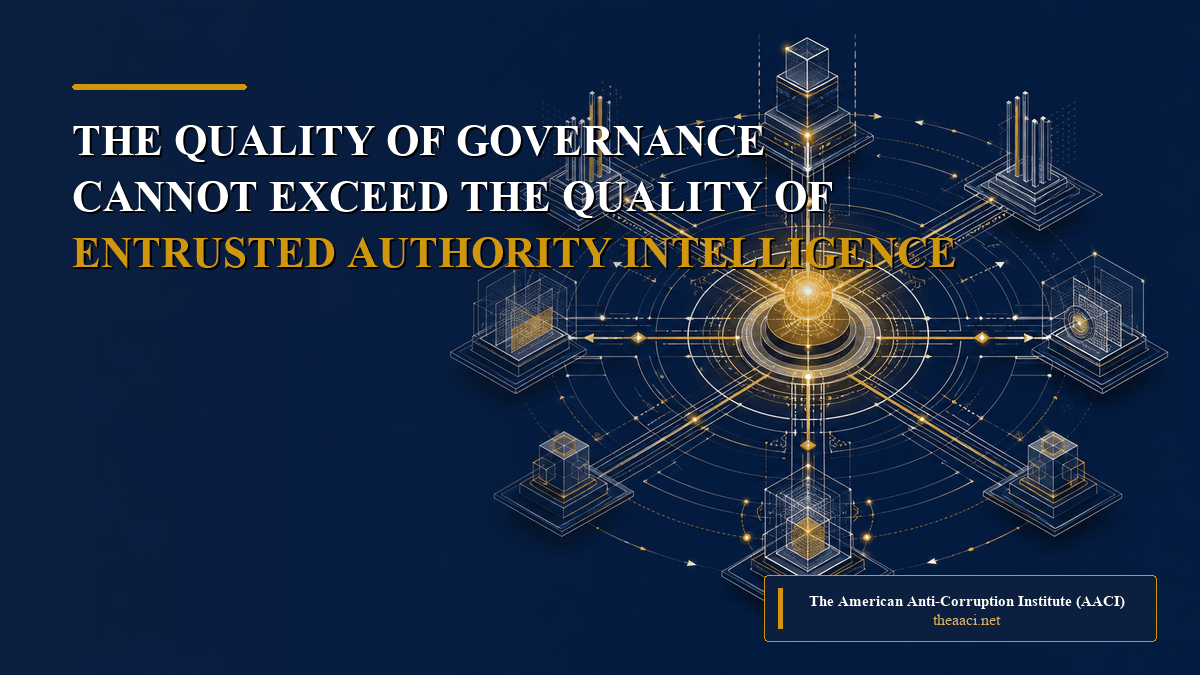
The quality of governance cannot exceed the quality of Entrusted Authority Intelligence possessed by those exercising authority within the governance system.
This perspective does not diminish the importance of governance structures. Rather, it recognizes that governance structures derive much of their effectiveness from the competence, integrity, and decision-making effectiveness of those entrusted to use them.
The Three Essential Elements

Entrusted Authority Intelligence rests on three essential elements:
Competence
Competence includes the knowledge, skills, experience, and understanding required to exercise authority responsibly.
Without sufficient competence, decision-makers may fail to recognize governance weaknesses, misunderstand risks, or make decisions that unintentionally increase organizational exposure.
Integrity
Integrity ensures that authority is exercised honestly, ethically, and in accordance with fiduciary responsibilities.
Competence without integrity may produce sophisticated misconduct rather than effective governance.
Decision-Making Effectiveness
Decision-making effectiveness represents the practical application of competence and integrity.
It reflects the ability to make timely, informed, objective-oriented decisions while appropriately managing risks and responsibilities.
Together, these three elements help explain why some individuals consistently exercise authority responsibly while others fail despite operating within similar governance environments.
Practical Applications
Entrusted Authority Intelligence is not merely a theoretical concept.
It has practical implications across both public and private sectors.
Boards of Directors
Boards carry ultimate responsibility for governance oversight, yet a board’s effectiveness depends on more than its formal composition or the policies it adopts. Directors who lack the competence to evaluate management assertions, the integrity to challenge decisions under pressure, or the decision-making effectiveness to act when warning signs emerge may fail in their oversight role regardless of how well the governance framework is designed. Entrusted Authority Intelligence provides boards with a practical lens for evaluating director effectiveness, identifying gaps in oversight quality, informing succession planning, and ensuring that governance education addresses not just knowledge but judgment.
Executive Management
Executive leaders exercise authority across strategy, resource allocation, personnel, risk management, and compliance. The quality of those decisions — not merely the existence of oversight mechanisms — determines much of an organization’s governance health. Entrusted Authority Intelligence encourages executive leaders to reflect not only on whether decisions are being made, but on whether they are being made with sufficient competence, integrity, and decision-making effectiveness. It also provides a framework for strengthening accountability within management layers, where delegation of authority is common and oversight of that delegation is often weak.
Public Officials
Public authority exists for public purposes. Entrusted Authority Intelligence provides a framework for evaluating whether that authority is exercised competently, ethically, and effectively in service of the public interest.
Regulators and Oversight Bodies
The concept encourages a shift from evaluating the mere existence of governance structures toward evaluating the competence, integrity, and decision-making effectiveness with which entrusted authority is exercised within them — a perspective with direct implications for how regulators design supervision and accountability frameworks.
Nonprofit Organizations
Trustees, directors, and officers of nonprofit organizations may use the concept to strengthen stewardship, accountability, transparency, and mission effectiveness.
The Central Proposition
The central proposition of Entrusted Authority Intelligence is straightforward:
This proposition does not suggest that effective governance guarantees success or eliminates risk.
Organizations operate in environments characterized by uncertainty, complexity, competing interests, and imperfect information.
Rather, it recognizes a practical reality:
Governance systems ultimately depend on the competence, integrity, and decision-making effectiveness with which entrusted authority is exercised within them.
The Question Every Organization Should Ask
Many organizations regularly evaluate policies, controls, compliance programs, risk management systems, and reporting mechanisms.
Far fewer evaluate the quality of the competence, integrity, and decision-making effectiveness of those exercising authority.
Explore the Full Concept
The complete concept paper is available on The American Anti-Corruption Institute (AACI) website:
Official Publication Page:
https://www.theaaci.net/Entrusted-Authority-Intelligence
Download the Full Publication
Readers wishing to review the complete publication may download the official PDF version from:
PDF Download:
https://news.theaaci.com/Entrusted-Authority-Intelligence
Suggested Citation
Masoud, M. (2026) Entrusted Authority Intelligence: An Anti-Corruption Governance Concept. The American Anti-Corruption Institute (AACI). Available at: https://www.theaaci.net/Entrusted-Authority-Intelligence (Accessed: [insert access date]).
Important Note
This article is provided for educational, research, governance, and professional development purposes only. It does not constitute legal, regulatory, accounting, auditing, compliance, investment, or other professional advice. Governance, fiduciary, regulatory, and legal obligations may vary by jurisdiction and circumstance. Readers should seek appropriate professional advice concerning their specific facts, circumstances, and applicable legal or regulatory requirements.